Accelerated Hip Replacement Rehabilitation
Available in:
EN
This case study is from the Practitioner’s Guide to Osteoarthritis and Joint Replacements and follows David Henderson’s independently managed recovery after total hip arthroplasty (THA). It explores how he used objective testing to guide loading, monitor progress and support his accelerated return to activity following THA.
Younger, active adults account for only about 5% of THA cases, yet their rehabilitation needs differ significantly from the older cohorts most guidelines are built around (Ratnasamy et al., 2025). Objective testing with VALD systems such as ForceDecks, ForceFrame and NordBord allowed me to tailor loading, monitor tissue tolerance in real time and progress safely at a pace that matched my capacity, bridging the gap between conservative protocols and the demands of a more athletic population.
…VALD systems such as ForceDecks, ForceFrame and NordBord allowed me to tailor loading, monitor tissue tolerance in real time and progress safely…
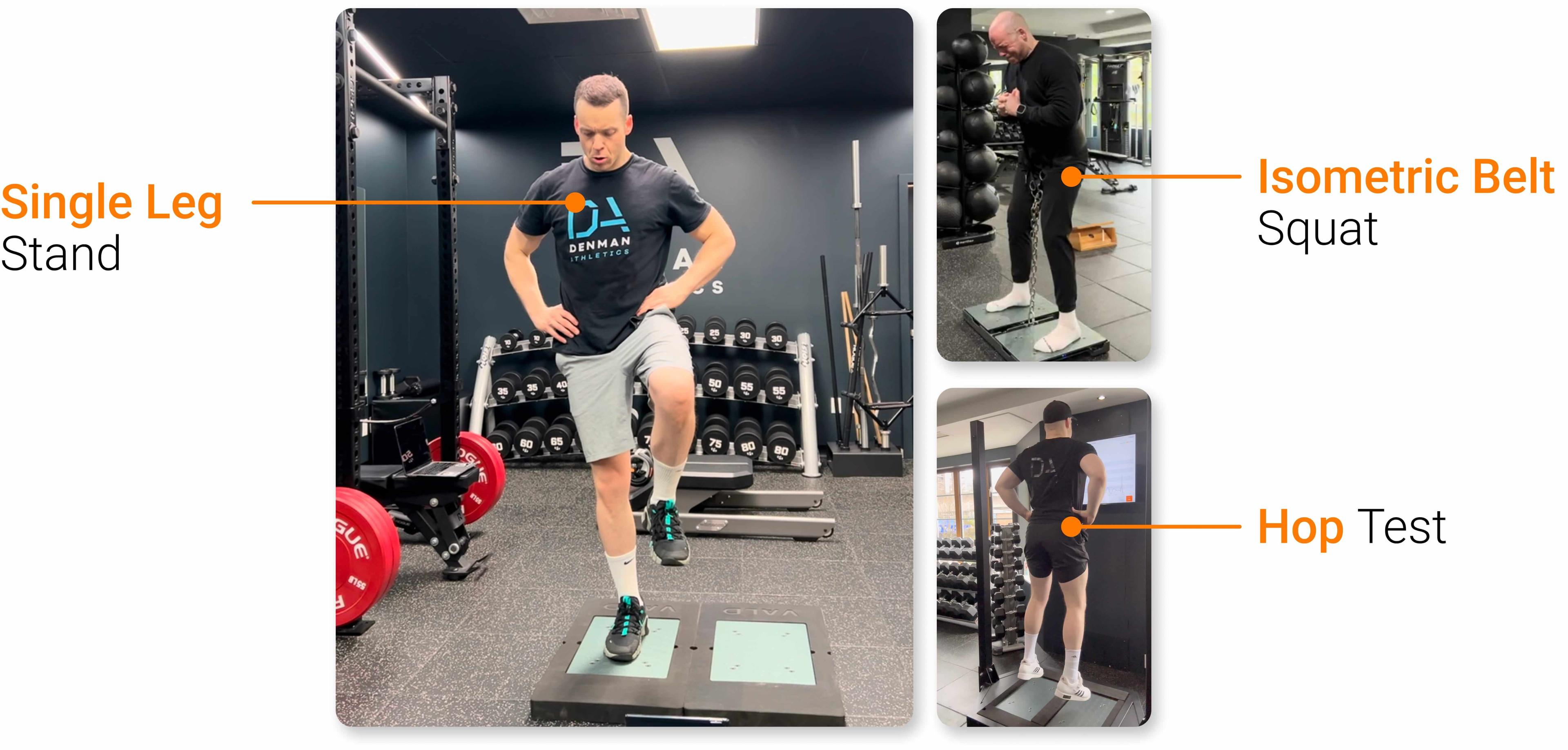
ForceDecks tests used to monitor balance, force production and reactivity during THA rehabilitation.
Approach to Monitoring and Training
My rehabilitation centered on continuous testing and threshold-based loading using objective measurement technology to elevate my rehabilitation and eventual training:
- NordBord: Tests such as the Isometric 30° (Iso 30°) and Nordic helped monitor hamstring strength.
- ForceFrame: Hip adduction and abduction testing in Training Mode allowed for early isometric loading and feedback.
- ForceDecks: Balance and functional tests such as the squat assessment helped track my progress using depth and power.
During the first few weeks after surgery, I used ForceFrame Training Mode to reintroduce safe muscle activation with live feedback, gradually increasing output thresholds as tolerated, but never by more than 10-15% each week. This feedback-driven approach helped provide consistency during rehabilitation, ensuring that the loads I prescribed were actually achieved.
During the first few weeks after surgery, I used…Training Mode to reintroduce safe muscle activation with live feedback, gradually increasing output thresholds…[by] 10-15% each week.
Early stages of testing and monitoring involved using ForceDecks to track my single leg balance capabilities through the single leg stand and single leg range of stability assessments. By monitoring my ability to maintain a stable base and my total excursion capacity, I was able to progress more confidently toward eventual strength assessments such as squatting and single leg strength training.
Training Progression
Rehabilitation focused on progressively restoring hip, trunk and posterior-chain capacity to improve load tolerance and prepare for higher-demand activities. Early-stage exercises were limited by post-operative range of motion (ROM) precautions; therefore, I emphasized trunk control in standing and supine positions, bridging and targeted isometric training in hip adduction and abduction with biofeedback using ForceFrame Training Mode. Early loading allowed for better tissue remodeling and provided an optimal healing environment during the first weeks after surgery.
As tissue capacity improved, rehabilitation progressed toward higher-load strength development through Romanian deadlifts (RDLs), machine-based hip adduction and abduction exercises and progressively loaded squats and split squats. With basic movement capacity restored, resistance training helped improve the strength required for running, jumping and eventual return to full training.
Objective Outcomes
Objective testing quantified progress with precision, while in-app Norms showed clear progressions in strength, symmetry, power and load tolerance across rehabilitation milestones.
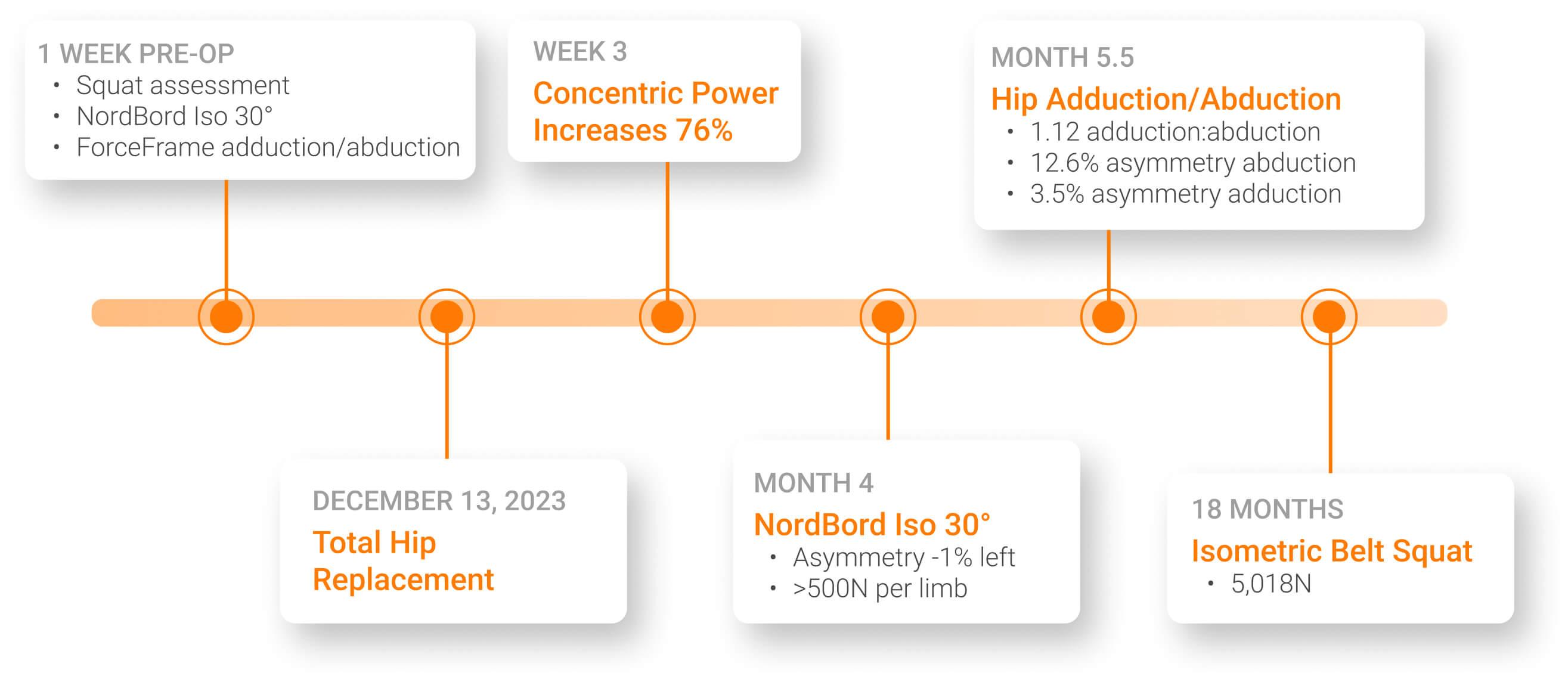
Timeline of key objective testing milestones from pre-op baseline to 18-month recovery.
NordBord data showed my hamstring asymmetry improving from 26% pre-op to near symmetry at −1% within 4 months. Strength also increased in both limbs beyond my pre-op levels, with the left limb increasing from 398N to 507N and the right limb increasing from 461N to 514N.
ForceFrame testing revealed my early abduction asymmetry was greater than 50%, which progressively normalized to 12.6% for abduction and 3.5% for adduction by 5.5 months, indicating restored frontal-plane stability.
On ForceDecks, my concentric peak power increased 76%, from 7.0W/kg to 12.4W/kg within 3 weeks, while ROM improved steadily. By 18 months post-op, my isometric belt squat force exceeded 5,000N, marking a clear return to high capacity and load tolerance.
| System | Test | Metric | Pre-Op and Early Post-Op | Recovered Metric | Change |
| NordBord | Iso 30° | Max force asymmetry | 26% to 16% right bias | −1% left bias at 4 months | Symmetry restored |
| Max force | Left: 398N; right: 461N | Left: 507N; right: 514N at 4 months | Left increased by 27%; right increased by 11% | ||
| ForceFrame | Hip adduction/ abduction 60° | Abduction and adduction asymmetry | >50% right bias | Abduction: 12.6%; adduction: 3.5% at 5.5 months | Progressive correction |
| ForceDecks | Squat assessment | Concentric peak power | 7.0W/kg | 12.4W/kg at 3 weeks | Increased by 76% |
| Isometric belt squat | Maximum vertical force | – | 5,018N by 18 months post-op | Capacity milestone |
By combining testing and training data, I could quantify progress with precision rather than perception. NordBord, ForceFrame and ForceDecks testing provided meaningful insights that enabled an accelerated return to activity, followed by continued progress over the following two years.
By combining testing and training data, I could quantify progress with precision rather than perception.
Clinical Takeaways
Objective thresholds provided both structure and confidence, turning each session into a measurable step forward rather than guesswork. Regular retesting across NordBord, ForceDecks and ForceFrame offered a clear, multidimensional view of my recovery – capturing strength symmetry, power return and frontal-plane stability.
For younger THA patients, individualized, data-driven progressions ensure rehabilitation matches capacity rather than arbitrary timelines. Having pre-op baselines and real-time feedback allowed me to progress safely, challenge appropriately and ultimately exceed my pre-op performance, demonstrating that objective testing and threshold-based training can restore both confidence and high-level function.
To learn more about using objective testing to guide hip replacement rehabilitation, explore our Practitioner’s Guide to Osteoarthritis and Joint Replacements or get in touch.
References
- Ratnasamy, P. P., Gouzoulis, M. J., Kaszuba, S. V., Rudisill, K. E., Vasudevan, R. S., Grauer, J. N., & Rubin, L. E. (2025). Indications and outcomes of total hip arthroplasty in patients aged 15 to 45 years. JAAOS: Global Research and Reviews, 9(12), e25.00042. https://doi.org/10.5435/jaaosglobal-d-25-00042
