EMP Onsite: Workplace wellness screening
Available in:
EN

This case study builds on EMP Onsite’s contribution to the Practitioner’s Guide to Workplace Wellness and demonstrates how objective screening can support proactive injury risk management, targeted intervention and measurable outcomes in a workplace screening environment.
EMP Onsite is a workplace health provider operating primarily in manual labor and high-risk industries. Their mission is to move beyond reactive injury management and instead identify leading indicators of injury risk before symptoms emerge. By combining objective physical capacity testing with task-based risk analysis, EMP aims to reduce workplace injuries, minimize injury-related time lost and provide measurable value to employers at scale.
Common Populations and Assessment Strategies
The populations that EMP supports often face productivity and cost challenges driven by upper-limb and repetitive manual task injuries. Risk is often concentrated in new starters, workers with prior injury and aging employees, many of whom may begin or return to work with reduced capacity.
Recognizing that traditional programs are largely reactive, EMP identified the need for earlier, objective insight into injury risk to better guide intervention and measure outcomes.
Recognizing that traditional programs are largely reactive, EMP identified the need for earlier, objective insight into injury risk…
EMP’s screening model integrates task exposure data with objective physical capacity testing. Portable and scalable measurement technologies such as DynaMo are used to assess joint- and muscle-specific capacity through dynamometry and isometric strength testing.
Grip strength, shoulder strength and isometric mid-thigh pull (IMTP) data are collected at scale, often during dedicated on-site testing and screening days, benchmarked against normative values and tracked over time to identify risk patterns. A multidisciplinary team of exercise physiologists, kinesiologists and data scientists conducts assessments using consistent, objective criteria.
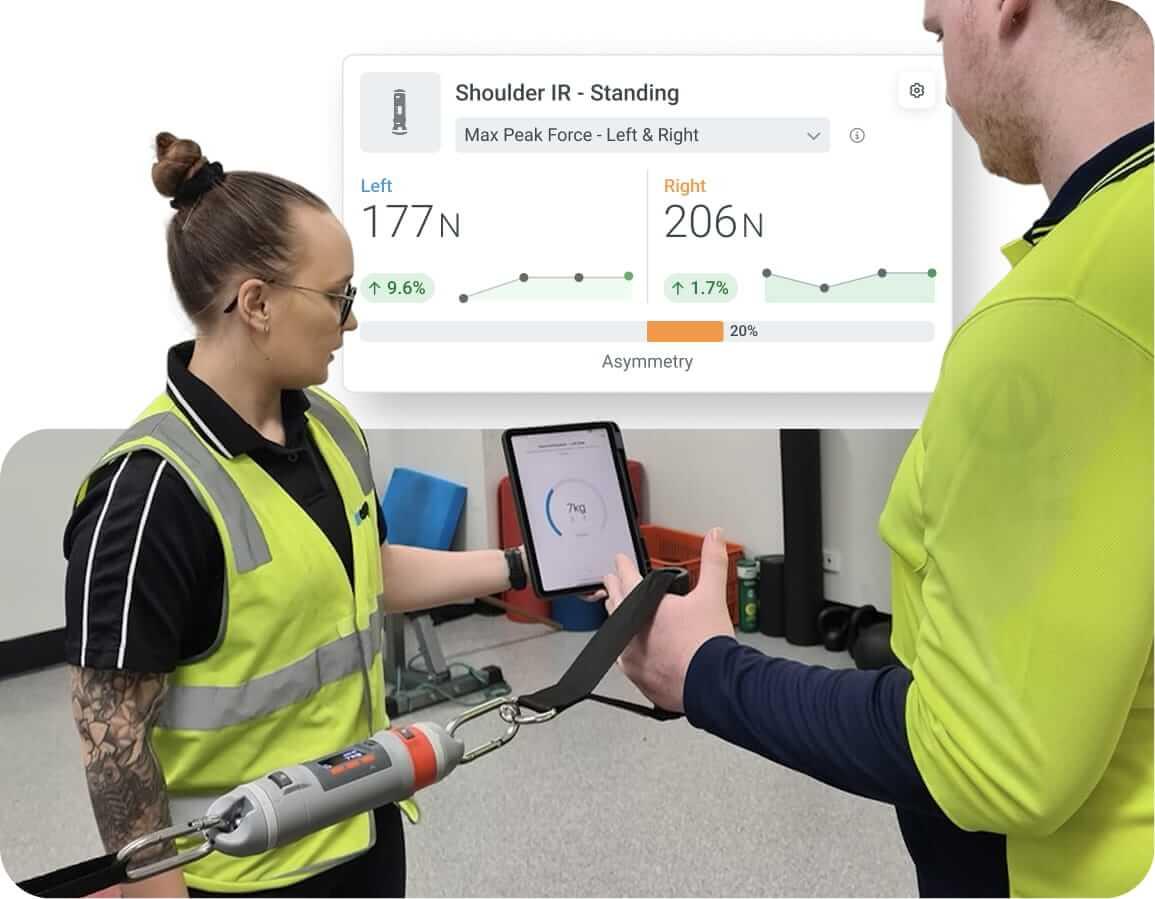
Longitudinal data tracking in VALD Hub helps practitioners monitor changes in strength and asymmetry over time.
Key Findings and Interventions
Screening consistently identified three high-risk groups, which then underwent further testing. These groups were new starters, workers with prior injury and aging workers. Objective data enabled EMP to stratify workers based on deviations from role- and age-specific benchmarks, rather than relying on symptoms alone. Interventions were then matched to risk level:
- Lower to Moderate Risk: Workers were managed through group-based strengthening and conditioning programs, improving efficiency and scalability.
- High Risk: Workers received targeted, individualized intervention informed by in-depth assessment of contributing factors such as joint strength, posture and movement capacity.
Once high-risk populations and deficits were identified, EMP practitioners provided data-informed recommendations on work modifications, strength and power training or outside rehabilitation consultations.
Objective retesting allowed EMP to quantify responses to intervention, with average functional improvements of approximately 22% across workers, supporting confident progression back toward role-specific benchmarks.
Objective retesting allowed EMP to quantify responses to intervention, with average functional improvements of approximately 22% across workers…
Return on Investment
Objective measurement significantly improved EMP’s ability to demonstrate return on investment (ROI). In one high-risk port and shipping workforce, injury claims fell from 14 per month to zero over six months, accompanied by a reduction in workers’ compensation costs of more than $30,000 per month.

When modeled over time, this equated to an estimated 5.5:1 ROI (approximately $900,000 in value over six months) through reduced claims and premium impact to the employer. Internally, the same data improved staff confidence and credibility, enabling clearer, evidence-based communication with executives and boards.
When modeled over time, this equated to an estimated 5.5:1 ROI (approximately $900,000 in value over six months) through reduced claims and premium impact to the employer.
Outcome and Practical Takeaways
By embedding objective measurement into workplace health screening, EMP shifted toward more data-informed decision-making. Large-scale physical testing using VALD technologies supported early risk identification, targeted intervention and objective outcome quantification.
The same objective data also provided EMP with a clear basis for demonstrating ROI and the financial value of technology-supported workplace screening. Key takeaways for practitioners and organizations include:
- Objective screening supports proactive injury prevention rather than reactive care.
- Normative benchmarking strengthens risk stratification across diverse workforces.
- Scalable testing supports both individual and group-level intervention strategies.
- Clear, outcome-driven reporting underpins strong ROI conversations with stakeholders.
To learn more about how objective workplace screening can help identify injury risk, guide targeted interventions and demonstrate ROI, explore our Practitioner’s Guide to Workplace Wellness or get in touch with our team.
