My Dashboard: Paul Wilson

My Dashboard is a series featuring insights from health and performance experts on the tests and metrics they use to identify performance and rehabilitation deficits. Each article includes an optimized VALD Hub dashboard outlining key tests, metrics and training interventions to help practitioners better integrate testing data into practice.
Contributor

Athlete Profile
A 29-year-old competitive marathon runner is returning from recurrent Achilles tendinopathy and patellofemoral pain resulting from sustained, repetitive loading of the lower extremities. Marathons demand efficient force application during brief ground contacts, sustained mechanical output over extended durations and sufficient tissue capacity to tolerate high training volumes. Each of these qualities required targeted assessment to guide both performance development and rehabilitation planning.
Marathons demand efficient force application during brief ground contacts, sustained mechanical output over extended durations and sufficient tissue capacity to tolerate high training volumes.
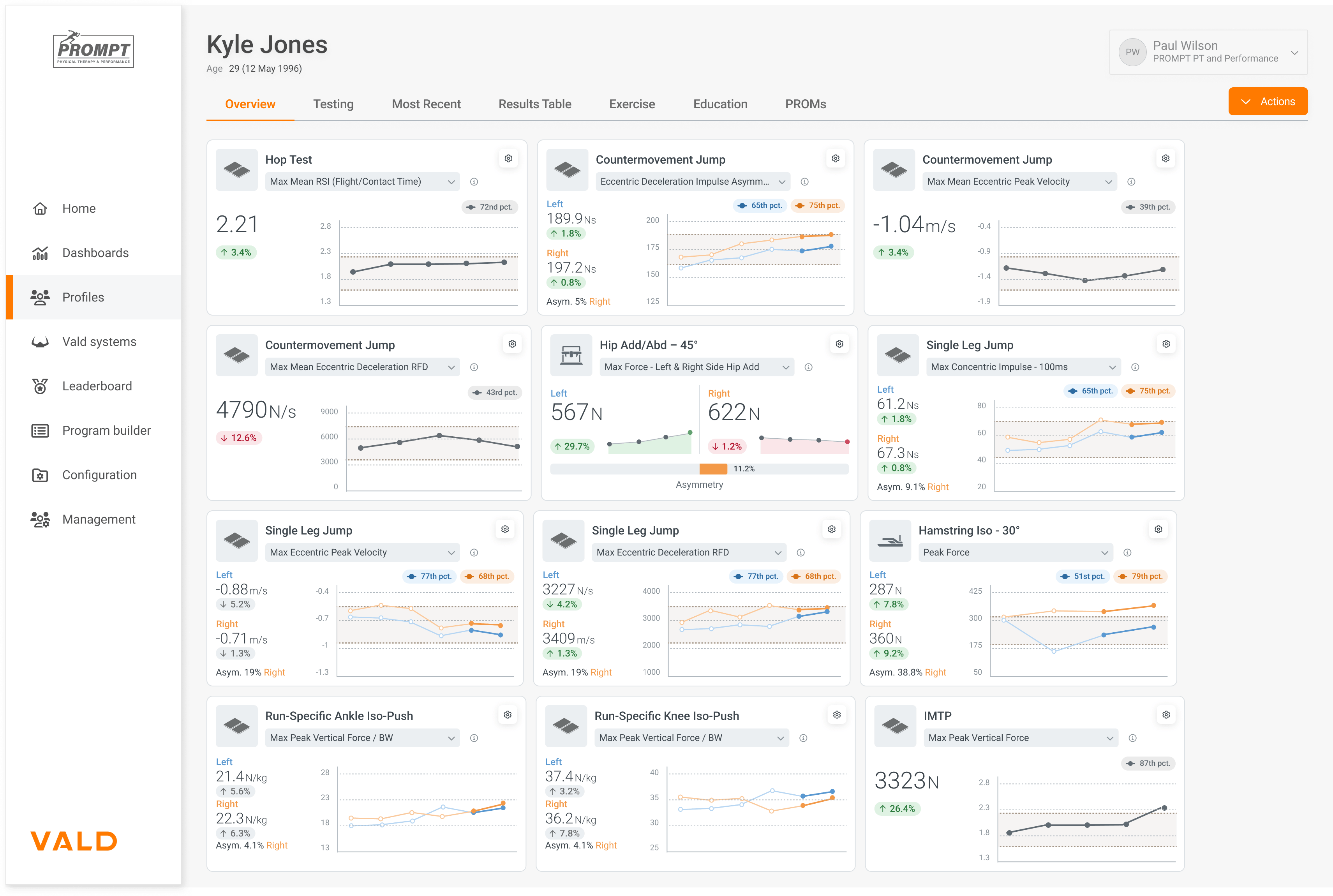
Paul Wilson’s VALD Hub dashboard highlighting the unique strengths and deficits of a marathon runner.
Overview
This dashboard depicts the tests and metrics Paul Wilson uses to profile runners, outlining force production, power and reactive strength capabilities across multiple tests. Each test indicates whether a runner has sufficient capacity and how effectively it transfers to running demands.
Hop Test

| Test | Metric | Exercise Prescription for Improvement |
 | Reactive Strength Index (RSI) |
|
| Impulse Asymmetry |
|
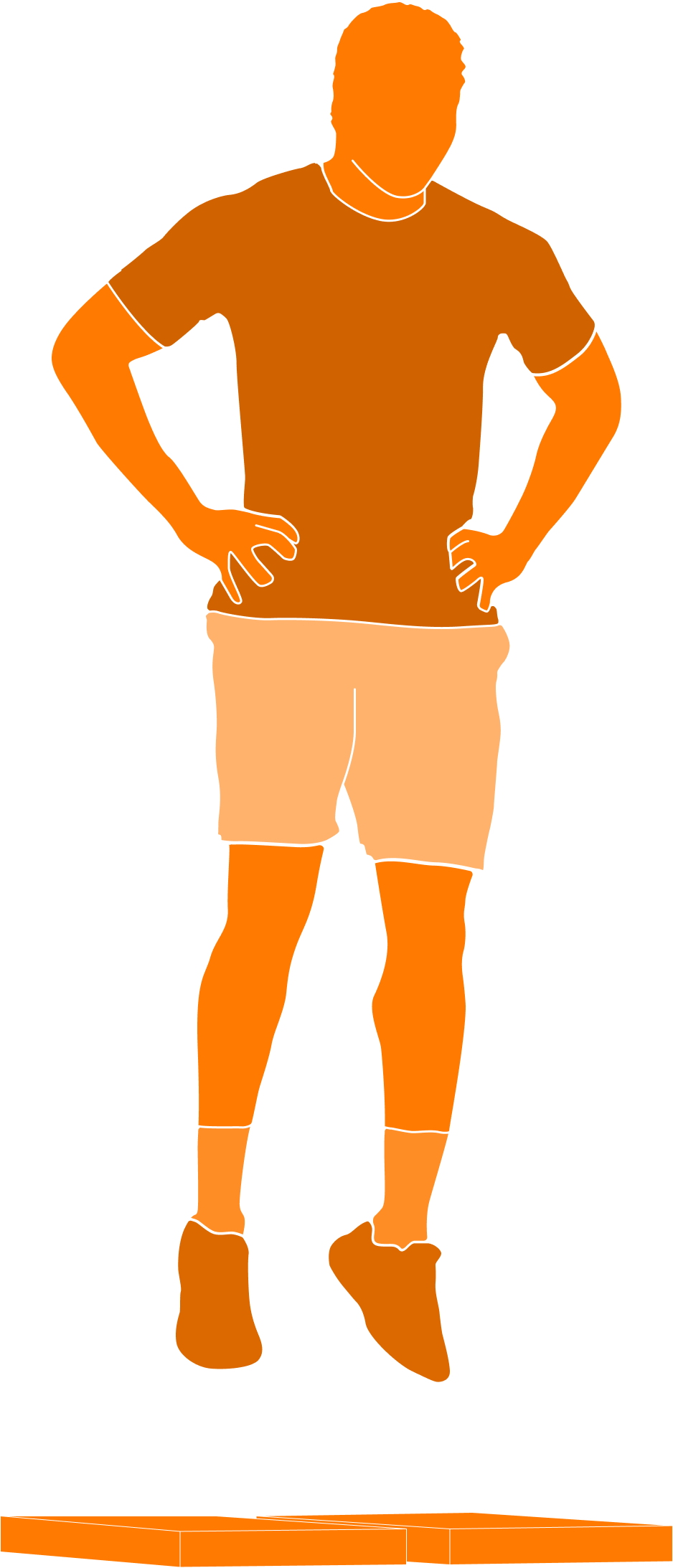
The hop test measures lower-limb stiffness and calf capacity under contact times and reactive strength demands similar to steady-state running. Double leg variations provide performance benchmarks and specific insights for runners undergoing lower-limb rehabilitation.
The hop test measures lower-limb stiffness and calf capacity under contact times and reactive strength demands similar to steady-state running.
RSI quantifies how efficiently force is applied during brief ground contacts, a key determinant of running economy. The hop test is therefore useful for guiding programming decisions in both healthy runners and those returning from injury.
Identified deficits can be addressed through targeted calf strengthening alongside progressive plyometric variations.
Countermovement Jump (CMJ)
| Test | Metric | Exercise Prescription for Improvement |
 | Peak Power / Body Mass (BM) |
|
| Eccentric Peak Velocity |
| |
| Eccentric Deceleration Rate of Force Development (EDRFD) |
| |
| Eccentric Impulse Asymmetry |
|
The CMJ provides a general indicator of lower-body power and symmetry. It allows practitioners to track changes in lower extremity power and jumping capacity over time, while also offering insight into eccentric capacity and symmetry during rehabilitation. Together, output and strategy metrics create a comprehensive neuromuscular profile with minimal testing burden.
Training interventions will vary by runner but typically include lower-body strength and power exercises, plyometrics emphasizing full eccentric-to-concentric transitions and drop-and-catch plyometric variations.
Single Leg Jump (SLJ)
| Test | Metric | Exercise Prescription for Improvement |
 | Peak Power / BM |
|
| Concentric Impulse 100ms | ||
| Eccentric Peak Velocity |
| |
| EDRFD |
When combined with CMJ data, the SLJ highlights how unilateral movement strategies differ from bilateral patterns, even when bilateral tests are assessed independently using dual force plate systems that allow side-to-side comparison (Cohen et al., 2020).
…combined with CMJ data, the SLJ highlights how unilateral movement strategies differ from bilateral patterns, even when bilateral tests are assessed independently…
This test is particularly valuable for runners returning from knee or hip injuries, as symmetry and SL capacity must be restored before progression to higher running volumes.
Although the SLJ is commonly associated with sports involving frequent change of direction, it remains a useful test in running sports that primarily involve forward locomotion. Addressing training deficits means integrating more unilateral exercises into strength and ballistic training.
Run-Specific Ankle Iso-Push
| Test | Metric | Exercise Prescription for Improvement |
 | Peak Force / Body Weight (BW) |
|
| Peak Force Asymmetry | ||
|
Impulse at 100ms |
|
The calf complex is a primary driver of propulsion during running, yet it is often undertrained relative to the demands placed upon it. Isometric strength, or peak force, in the calf complex contributes to efficient storage and release of elastic energy in the Achilles tendon.
The calf complex is a primary driver of propulsion during running, yet it is often undertrained relative to the demands placed upon it.
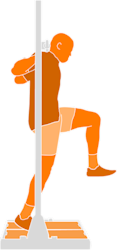
The Run-Specific Ankle Iso-Push assessment provides objective measures of calf strength in a position that closely approximates running-specific loading. Peak force / BW is the key metric, helping determine whether sufficient capacity exists to support training volume and intensity.
Benchmark peak force targets:
- Females: 24-27N/kg
- Males: 29N/kg
Training includes isolated calf strengthening through traditional isotonic work and Run-Specific ankle isometrics. Strength drills, floating-heel split squats and tiptoe carries address foot coordination and endurance, while forefoot-cued plyometrics promote pre-emptive ankle stiffness to better manage force through the calf-Achilles complex.

Run-Specific Knee Iso-Push
| Test | Metric | Exercise Prescription for Improvement |
 | Peak Force / BW |
|
| Asymmetry |
| |
| Impulse 100ms |
|
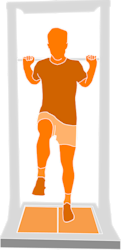
The Run-Specific Knee Iso-Push replicates the midstance position of running, where maximal forces are experienced, allowing force production capacity to be quantified at a critical phase of gait. This assessment directly informs whether knee extensor strength is sufficient to meet the demands placed on the runner’s body during training.
The Run-Specific Knee Iso-Push…directly informs whether knee extensor strength is sufficient to meet the demands placed on the runner’s body during training.
Benchmark peak force targets:
- Females: 34N/kg
- Males: 39N/kg
Targeted interventions emphasize knee-dominant lower-body strength with an upright trunk position. Programming typically includes intensive plyometrics such as CMJs, split-stance jumps and drop jumps, alongside isotonic loading strategies like heavy calf raises to develop force and reactive capacity.
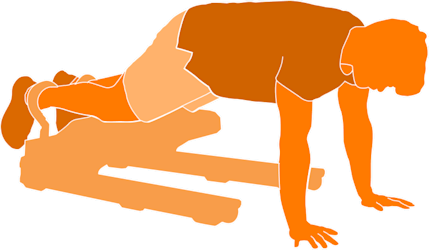
Isometric Knee Flexion – 30° (Iso 30)

| Test | Metric | Exercise Prescription for Improvement |
 | Peak Force |
|
| Peak Force Asymmetry |
|
Hamstring strength during midstance loading supports efficient running mechanics and helps prevent proximal hamstring tendinopathy, a common injury in competitive distance runners. The Iso 30 assessment on NordBord provides insight into posterior chain capacity in a running-specific load profile.
Hamstring strength during midstance loading supports efficient running mechanics and helps prevent proximal hamstring tendinopathy…
Benchmark peak force targets:
- Females: >250N
- Males: >300N
Subsequent training interventions involve strength exercises that primarily recruit posterior chain musculature (e.g., hamstrings and gluteals).
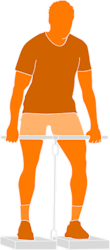
Isometric Mid-Thigh Pull (IMTP)
| Test | Metric | Exercise Prescription for Improvement |
 | Peak Force |
|
The IMTP serves as the primary indicator of overall strength and force production capacity. When analyzed alongside Run-Specific Isometric tests, IMTP data reveals whether a runner requires focused strength development or whether training emphasis should shift toward plyometric capacity and running-specific force application.
…IMTP data reveals whether a runner requires focused strength development or whether training emphasis should shift toward plyometric capacity and running-specific force application.
Benchmark peak force targets:
- Females: 29-34N/kg
- Males: 34-39N/kg
Training interventions involve exercises that produce force using the entire kinetic chain from the ground up.
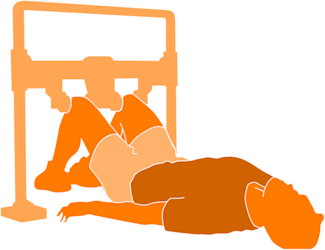
Hip Abduction at 45°

| Test | Metric | Exercise Prescription for Improvement |
 | Peak Force |
|
Hip abduction at 45° assesses lateral hip strength in a position that approximates midstance during running. Peak force indicates whether the hip abductors can effectively stabilize the pelvis under load, helping guide decisions around the prioritization of lateral strength training.
Benchmark peak force targets:
- Females: 300N
- Males: 400N
Training interventions involve core exercises that integrate the thorax and pelvis in a similar capacity to support the pelvis, as well as strength and plyometric exercises that involve unilateral movement.
How These Tests Integrate
These assessments create a comprehensive strength and power profile tailored to the demands of distance running. The IMTP establishes overall force production capacity, while Run-Specific Isometric tests determine whether that capacity exists in positions and joint angles relevant to running mechanics.
Dynamic tests (e.g., hop test, CMJ, SLJ) reveal how effectively runners apply their strength during high-rate tasks with brief ground contacts. When improvements in isometric force capacity align with increases in RSI or jump height, practitioners gain confidence that strength development is transferring to dynamic performance.
Hip abduction testing complements this framework by ensuring lateral stability can support the repetitive, cyclical demands of distance running without compensation patterns that may contribute to injury.
Together, these tests determine whether a runner possesses adequate athletic capacity for their training volume and whether that capacity translates to efficient force application during running. This framework guides decisions about when to emphasize strength development, when to focus on plyometric qualities and when to reduce strength volume to prioritize running-specific training.
This framework guides decisions about when to emphasize strength development, when to focus on plyometric qualities and when to reduce strength volume to prioritize running-specific training.
Interested in building your own dashboard or applying similar methods to running performance and rehabilitation? Get in touch with our team.
References
- Cohen, D., Burton, A. M., Wells, C., Taberner, M., Díaz, M. A., & Graham-Smith, P. (2020). Single vs double leg countermovement jump tests: Not half an apple! Aspetar Sports Medicine Journal, 9, 34–41. https://www.aspetar.com/journal/upload/PDF/202069164457.pdf
