ACL Rehabilitation: What I wish every clinician did
Available in:
EN

For decades, clinicians working in anterior cruciate ligament (ACL) rehabilitation have relied on well-established but incomplete assessments as proxy measures for knee function and return-to-sport readiness.
Assessments like horizontal hop tests, timeline-based healing criteria and repetition-maximum (RM) strength assessments still have direct clinical value. However, they serve as surrogate measures of the actual qualities clinicians hope to uncover, such as strength and power, which ultimately inform return-to-sport readiness.
…horizontal hop tests, timeline-based healing criteria and RM strength assessments…serve as surrogate measures of the actual qualities clinicians hope to uncover…
One of the biggest changes I have made in my own practice over the last decade has been the shift toward objective assessment. Clinical reasoning will always remain the sole responsibility of the clinician, but technology-enabled assessments delivered through systems such as ForceDecks, DynaMo and NordBord provide clinicians with better inputs to support high-quality, informed decision-making.
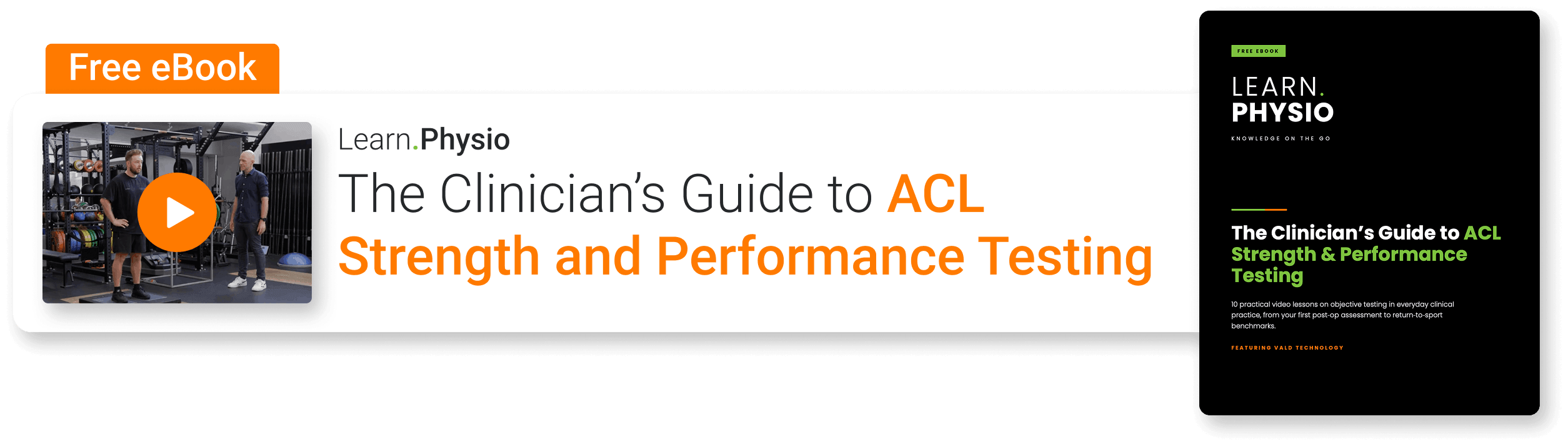
With this in mind, I created the Learn.Physio Clinician’s Guide to ACL Strength and Performance Testing, a free resource with practical video lessons on objective testing in everyday clinical practice.
A patient can look excellent in the weight room at six months after ACL surgery while still carrying substantial deficits in quadriceps strength, hamstring capacity or jumping performance. With this guide, clinicians can better identify these deficits and target them with systems purpose-built to detect what our eyes cannot see.
Testing Should Change What You Do Next
Many clinicians fall into a trap of collecting more and more data, rather than ingesting, analyzing and applying that data to the patients they see. The purpose of objective testing is ultimately to highlight a strength or capacity deficit that changes a plan of care.
The same principle applies to when testing is performed. Testing and retesting at arbitrary set points in rehabilitation follow the same rationale as the outdated timeline-based progression model. Clinicians test based on assumed readiness for progression, given the time since surgery.
Timelines are not inherently wrong; however, before clinicians begin testing, they should identify the questions they hope to answer about the patient. These questions might include:
- Is this patient’s quadriceps strength improving?
- How does this patient’s hamstring strength compare to their peers?
- Does this patient have sufficient power and deceleration ability to begin running?
- Does this patient’s movement strategy make progression to higher-intensity activities too risky?
If the results do not influence exercise prescription or progression, the test is probably not worth performing.
If the results do not influence exercise prescription or progression, the test is probably not worth performing.
That philosophy sits at the center of the Learn.Physio Clinician’s Guide to ACL Strength and Performance Testing, where assessments are discussed practically as methods to answer key questions in clinical practice.
We Cannot See Strength
One of the biggest misconceptions in rehabilitation is believing we can estimate strength from movement quality. While movement quality itself may be a key performance indicator (KPI) in rehabilitation, patients can compensate extremely well.
Hop distance symmetry, squats without a hip shift, visually symmetrical jump landings and equal change-of-direction performance between sides are all possible with a significant quadriceps strength deficit. Conversely, a patient who appears hesitant may actually possess excellent strength but simply lack confidence.
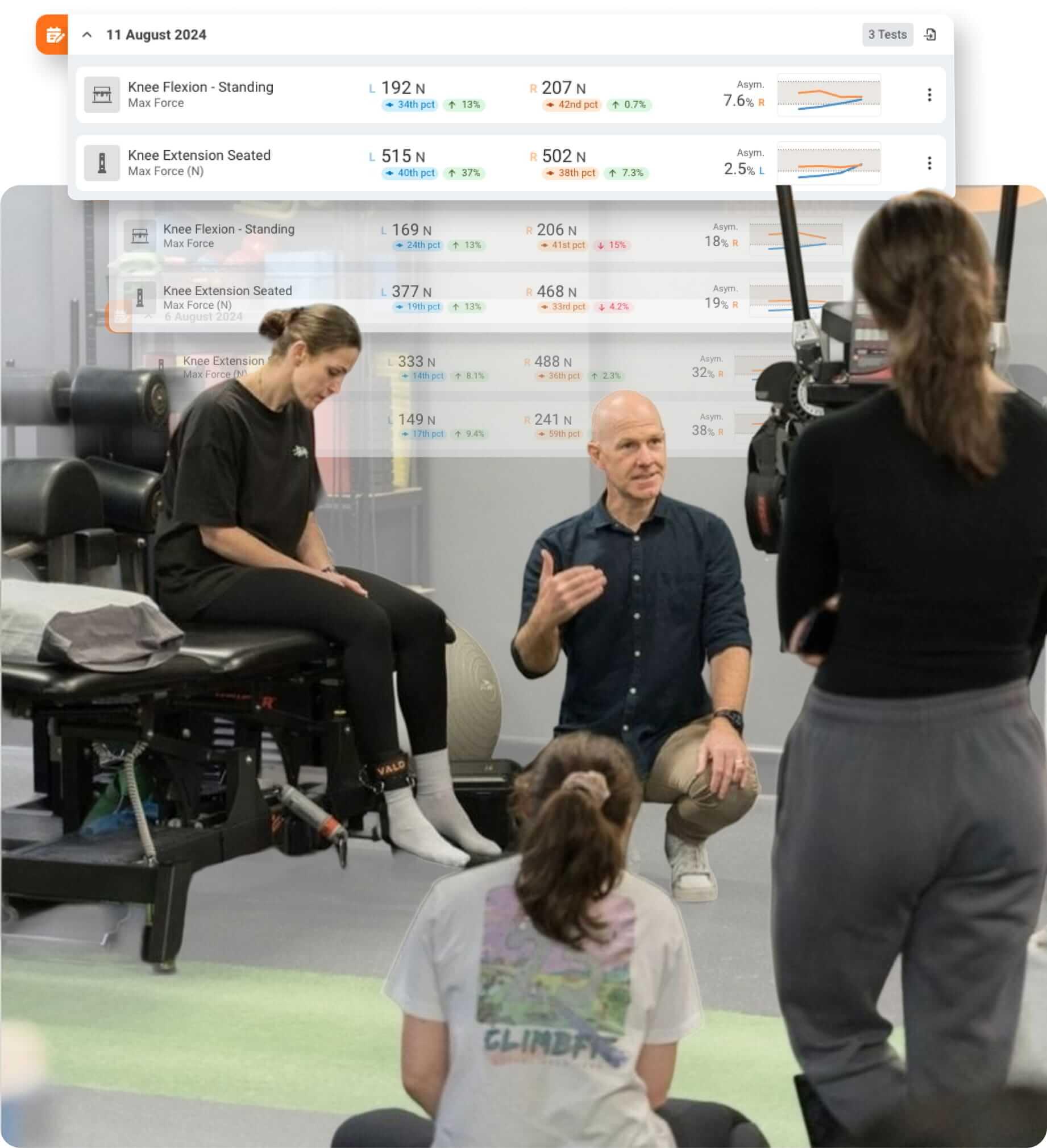
Timeline View in VALD Hub allows clinicians to visualize progress from session to session, enabling a better understanding of longitudinal progress during rehabilitation.
Without objective testing, a patient who is strong, symmetrical and powerful can appear remarkably similar to a patient who lacks those same performance qualities. These comparisons highlight the need not only to test but also to do so at key inflection points during rehabilitation, when uncertainty about progression or readiness is heightened.
Strength Comes First
Strength is the underpinning capacity required in nearly all athletic and functional tasks. Jumping, running, deceleration and eventual return to sport all depend on having sufficient force-production capacity.
This is why quadriceps testing sits at the beginning of the assessment process and why it is the longest and most in-depth video included in the Learn.Physio Clinician’s Guide to ACL Strength and Performance Testing.
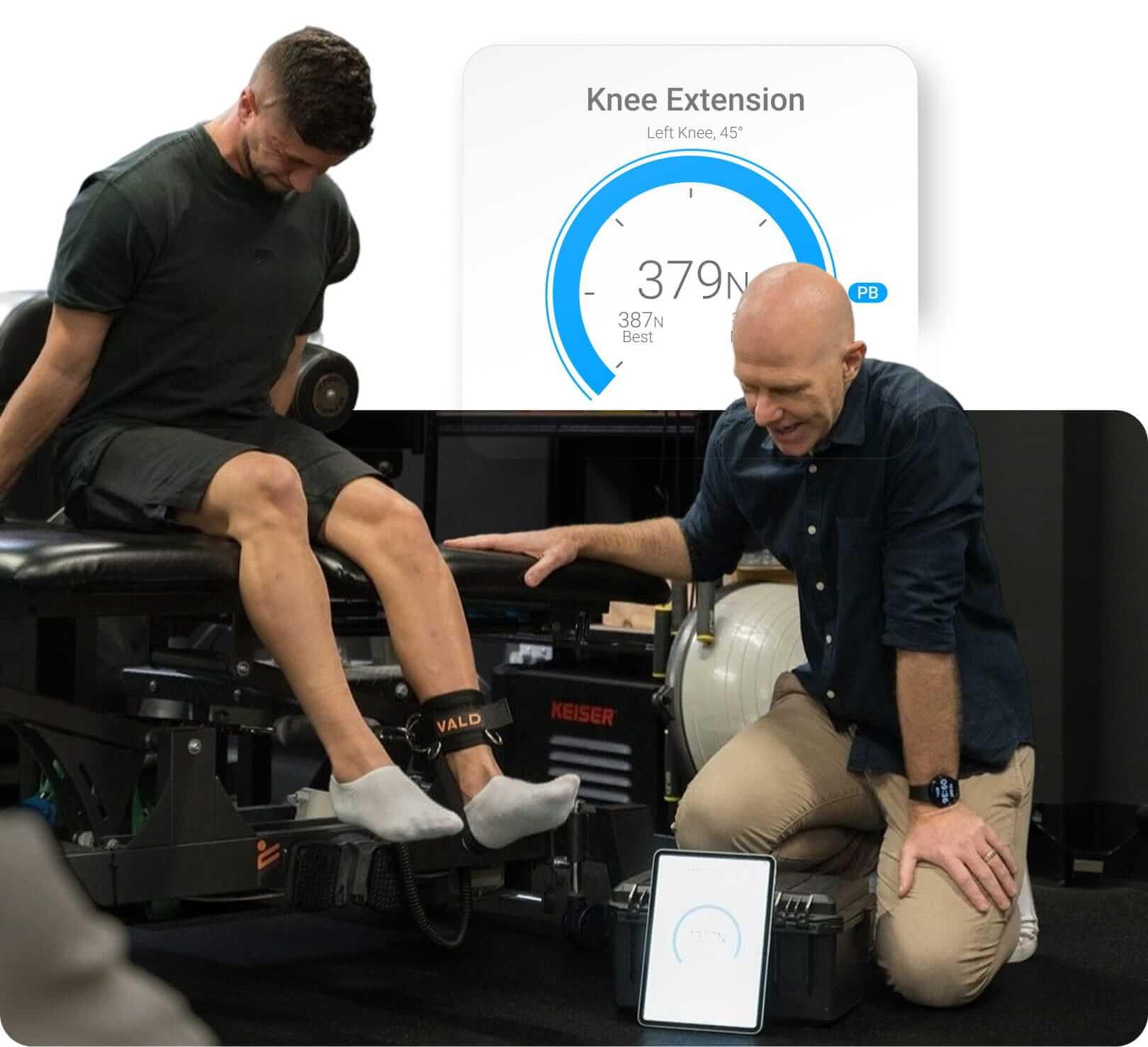
Knee extension strength assessment using DynaMo Plus.
In-line or fixed-frame dynamometry enhances reliability by removing the clinician as a potential source of error in the assessment. Testing at 60° of knee flexion has become the clinical standard due to its high force potential, repeatable position and research-supported reliability.
Importantly, while symmetry is still considered, it is not the end goal. Limb symmetry can still be insufficient if both limbs are considerably weak. Therefore, normalizing strength to body weight helps determine whether the patient has rebuilt sufficient capacity relative to their own body weight rather than simply matching the opposite limb.
Limb symmetry can still be insufficient if both limbs are considerably weak. Therefore, normalizing strength to body weight helps determine [readiness for progression]…
Do Not Forget the Hamstrings
Hamstring strength often receives less attention than quadriceps strength, particularly once patients return to heavier compound lifting. While quadriceps deserve the attention that they receive, the importance of hamstring strength cannot be overstated.
Deadlifts and hip-dominant exercises certainly improve hamstring strength. However, hamstring tendon grafts often influence both hip extension capacity and knee flexion capacity. Without regular assessment through high-load isometric and eccentric tests such as the isometric 30° (ISO 30°) and Nordic tests, hamstring deficits can easily be masked.
Together, eccentric and isometric assessments on NordBord help identify whether a patient has restored strength across different portions of the force curve and whether targeted knee-flexion work should remain in the program.
Together, eccentric and isometric assessments on NordBord help identify whether a patient has restored strength across different portions of the force curve…
Vertical Testing Tells a Different Story
Single leg hop tests remain an important part of ACL rehabilitation because they assess functional performance in a simple, accessible way. However, research over the past decade has demonstrated that horizontal hop performance alone may overestimate recovery (Kotsifaki et al., 2023).
Patients commonly achieve near-symmetrical hop distances while still demonstrating meaningful deficits in vertical jumping performance and force production, suggesting they have developed movement strategies that compensate for persistent impairments rather than fully restoring lower-limb function.
This is where vertical jump testing adds value. Assessments such as the single leg countermovement jump challenge the lower limb in different ways and have been shown to identify asymmetries that are often missed by traditional horizontal hop tests.

When performed on ForceDecks, clinicians can examine how each limb contributes during the eccentric and concentric phases of the movement. Metrics such as eccentric peak velocity, eccentric deceleration impulse and reactive strength index-modified (RSI-Mod) provide insight into a patient’s jump strategy, helping contextualize more common metrics like jump height.
Rather than replacing hop testing, vertical jump assessments complement it by providing a more complete picture of lower-limb recovery. Together with objective strength testing, they help clinicians identify the impairments that continue to limit performance, guide exercise selection and build greater confidence in rehabilitation progression and return-to-sport decision-making.
Rather than replacing hop testing, vertical jump assessments complement it by providing a more complete picture of lower-limb recovery.
Context Always Matters
Objective testing gives clinicians the context needed to interpret rehabilitation progress, identify meaningful deficits and make more informed decisions throughout the recovery process.
The same strength or performance result may be entirely appropriate early after surgery, encouraging during mid-stage rehabilitation or indicative of a need for further intervention before returning to unrestricted sport. Interpreting these measures within the context of the patient, rather than in isolation, allows rehabilitation to progress with greater confidence and precision.
The Learn.Physio Clinician’s Guide to ACL Strength and Performance Testing brings together the assessment protocols, practical benchmarks and clinical reasoning that underpin this approach. Through 10 concise lessons and accompanying video demonstrations, clinicians can learn how to implement objective testing in everyday practice and use the results to guide rehabilitation, improve patient communication and support return-to-sport decision-making.
To learn more about how VALD systems can support objective testing in ACL rehabilitation and return-to-sport decision-making, get in touch.
References
- Kotsifaki, R., Sideris, V., King, E., Bahr, R., & Whiteley, R. (2023). Performance and symmetry measures during vertical jump testing at return to sport after ACL reconstruction. British Journal of Sports Medicine, 57(20), 1304–1310. https://doi.org/10.1136/bjsports-2022-106588
