Building Trust Through Objective Testing
Available in:
EN

Prodigy Performance and Rehab works with athletes across the full arc of care, from initial injury through return to competition and ongoing performance training. That continuity is supported by a structured objective testing model that helps practitioners assess athlete readiness, guide programming and monitor progress over time.
Throughout rehabilitation and return-to-sport testing, Prodigy uses objective assessment technology, including ForceFrame, DynaMo and ForceDecks, to help determine whether an athlete is ready to progress to the next training phase or return to competition. Because this testing mirrors standardized protocols used in collegiate and professional environments, it also creates a shared language for athletes, families, schools and college programs.
What does Prodigy’s testing model look like?
Standardized testing helps us guide decision-making with objective data rather than relying only on subjective feedback or visual observation. Across rehabilitation and performance training, test results from assessments such as shoulder internal and external rotation, countermovement jump (CMJ) and isometric mid-thigh pull (IMTP) help identify deficits, track progress and communicate performance changes more clearly with athletes and families.
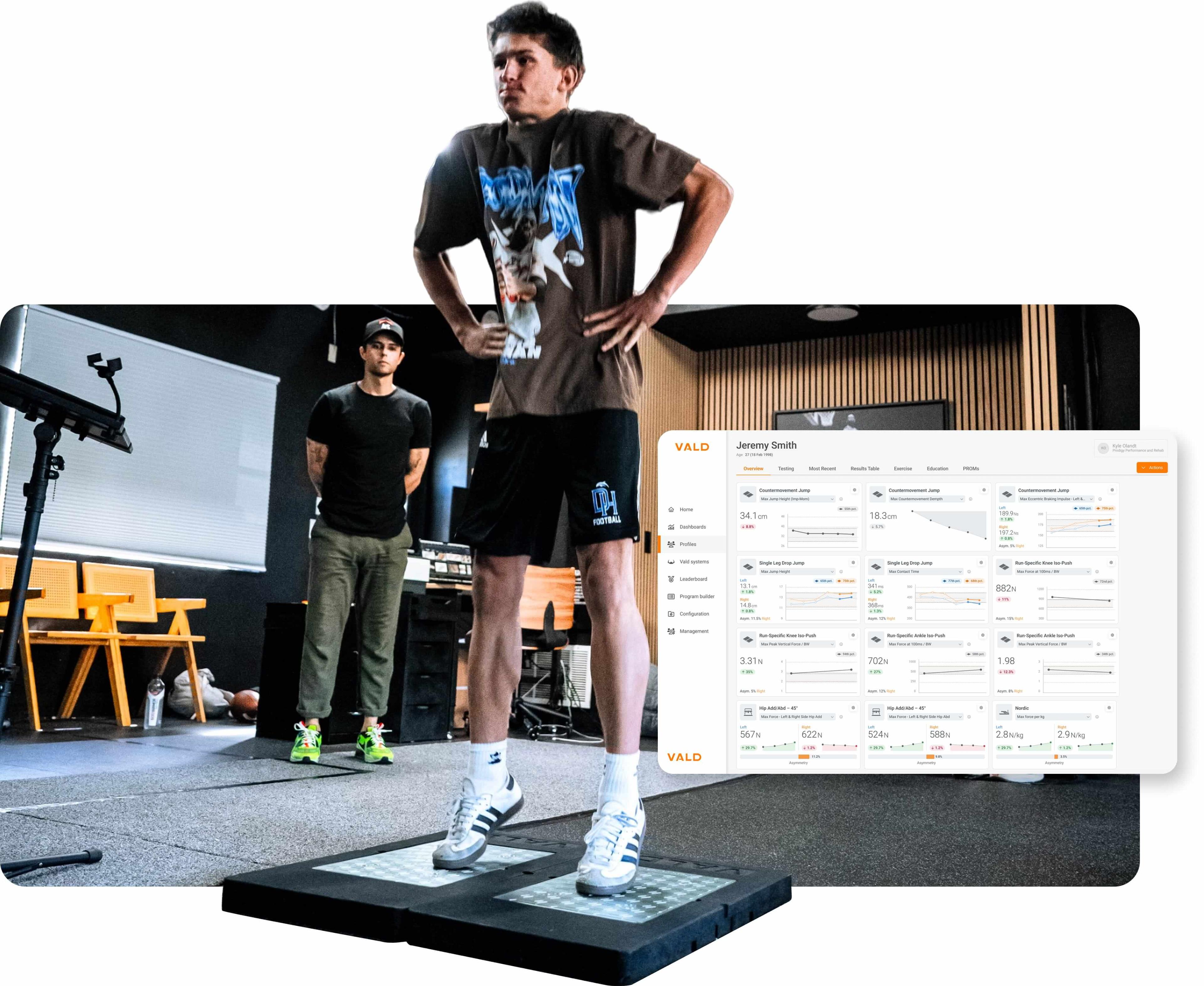
An athlete performing a CMJ using ForceDecks, with their profile highlighting performance characteristics and deficits during rehabilitation.
Standardized testing helps us guide decision-making with objective data rather than relying only on subjective feedback or visual observation.
Our testing cadence involves an initial assessment and monthly return-to-sport testing tailored to the injury before clearance for phase progression. We typically reassess rehabilitating athletes once a month, using the data to provide feedback and inform future training goals. Healthy athletes participating in performance training are also retested every four to six weeks before their training is updated.
Assessments can vary depending on an athlete’s injury and current capabilities, but some core tests include:
| Quality | System | Test | Metrics |
| Shoulder Rotational Strength | ForceFrame | Shoulder internal and external rotation – supine with 90° abduction |
|
| Trunk Rotational Strength | DynaMo | Trunk rotation – seated |
|
| Jump Performance and Lower-Body Power | ForceDecks | CMJ |
|
| Maximal Strength | IMTP |
|
Having objective methods to measure progress after the initial assessment keeps athletes engaged in their own process, whether they’re returning from injury or tracking performance changes over time.
How does testing support long-term retention?
Integrating a data-informed approach has supported long-term retention, as athletes choose to stay and train in-clinic to achieve performance goals after finishing rehabilitation, creating an additional service offering for the clinic.
…athletes choose to stay and train in-clinic to achieve performance goals after finishing rehabilitation, creating an additional service offering for the clinic.
While most athletes train in-clinic multiple times per week, testing allows us to screen athletes, send them home with tailored programming and retest them periodically before updating their training. This option supports athletes who want to continue working with us while away at college, as well as families who cannot commit to frequent one-on-one sessions.
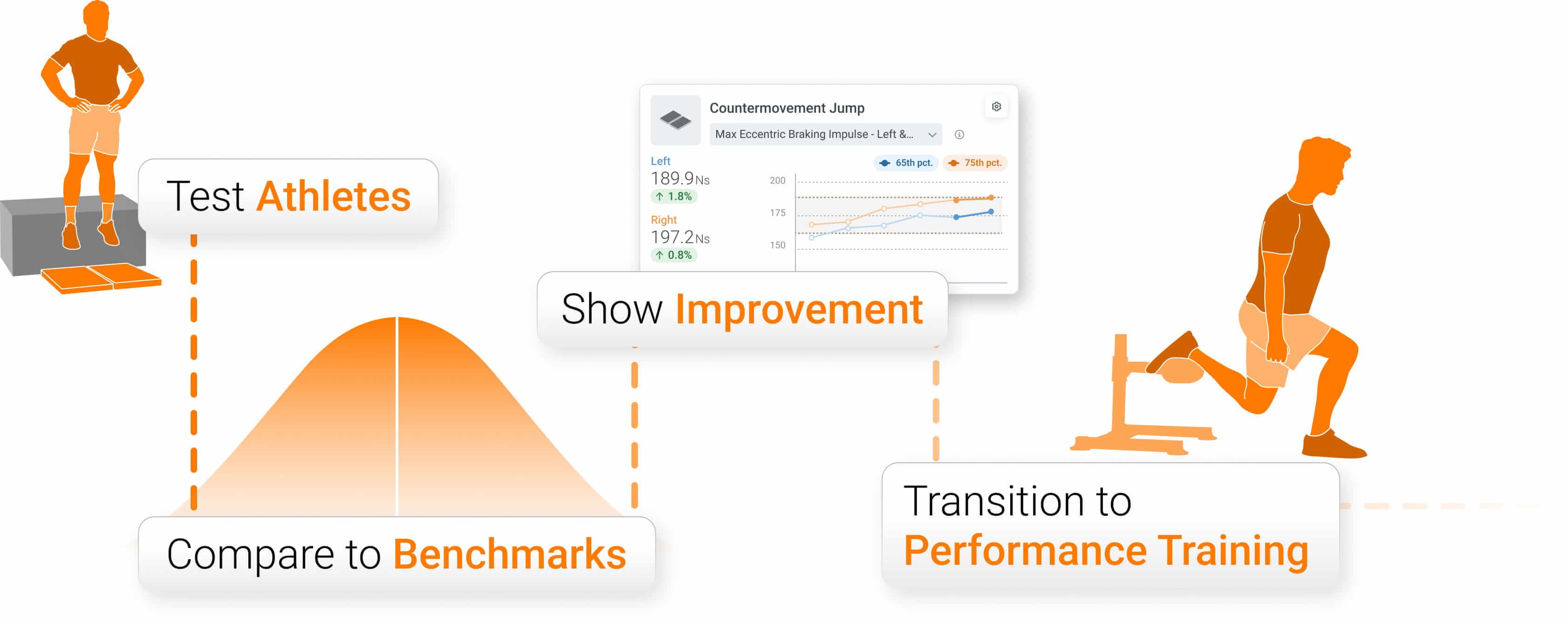
This approach has helped us build credibility in the local community and with outside teams and school programs nationwide.
What opportunities has testing helped establish?
Before integrating objective testing, we had limited community outreach. Objective testing has enabled the clinic to run pop-up combine events to build our local reputation by giving athletes objective feedback on their current capabilities, while also introducing our data-led approach to families, schools and teams.
Objective testing has enabled the clinic to run pop-up combine events to build our local reputation…
Pop-up testing sessions at local tryouts and schools allow us to screen large groups at once, often 30 to 40 athletes in a single session. We bring testing technology on-site or set it up at satellite locations for recurring testing events. Objective testing technology, such as VALD systems, can help flag major performance limiters and physical qualities that may increase future injury risk.
For most athletes, this serves as their first introduction to testing and helps them see how objective data can refine their current training. Results, along with a small set of starting exercises, are shared directly with families, giving them an introduction to our overarching model regardless of whether they become clients.
Tests used at a combine can vary based on sport, site setup and logistics. Pop-up tests are meant to provide a snapshot of certain performance qualities relevant to a given sport. These tests are simple, efficient and effective for athlete profiling, keeping a single combine session manageable even when working with a large group in a short window.
Athletes are then invited into the clinic for more robust testing if they’re interested in learning more about their current performance capabilities.
As a result, combine testing and shared reporting have become a consistent source of new relationships for the clinic. Athletes screened at a pop-up combine often return when a flagged deficit becomes symptomatic or when they want a more detailed understanding of their performance profile.
How does testing build trust outside of the clinic?
Testing has helped us build trust with schools and universities. Shared standardized testing protocols help bridge a historical gap between private-sector practitioners and school or university programs.
Shared standardized testing protocols help bridge a historical gap between private-sector practitioners and school or university programs.
Because we use tests and metrics that align with those used by college staff, conversations shift from subjective, informal history to shared, quantitative data that validates offseason work done outside of team care. From a business perspective, this has significantly improved our return on investment (ROI) and strengthened our local reputation in the community.
For example, sharing trunk rotational strength results directly with a university strength coach has helped coordinate programming for an athlete with a history of lumbar stress fractures. This positions us as a recognized contributor willing to collaborate in that athlete’s care rather than an outside provider offering a second opinion.
This also extends to non-injured athletes sharing performance data. Because this data can include tests used by college programs, it’s received as a continuation of trusted testing records rather than an unfamiliar outside assessment, reinforcing our standing as a reliable source of pre-collegiate athlete care.
Sharing objective test results with university strength coaches or medical staff can open channels to coordinate offseason programming and retesting for athletes with significant injury histories. Depending on the organization, we may meet with staff and share reports to optimize athlete care, providing injury-history context and recent performance results where relevant.
Over time, schools and teams have come to trust us after seeing the clinic’s data-driven approach, sending more athletes for offseason training or rehabilitation because the level of care aligns with their standards.
What can practitioners take from this model?
Our approach shows how objective testing can support more than clinical decision-making. When used consistently, it can help private practice clinics communicate progress more clearly, keep athletes engaged beyond the initial assessment and build stronger relationships with athletes, families and external stakeholders.
Building credibility through objective testing does not require a large operation. Using consistent protocols, communicating results in language already familiar at the collegiate level and incorporating small-scale combine testing can help establish a practice as a trusted, data-driven resource among local schools and teams, extending its reach beyond individual athletes and into the broader sporting community.
If you would like to learn more about how objective testing can support athlete care, long-term retention and stronger relationships with schools and teams, get in touch with our team.
