My Dashboard: Fearghal Kerin
Available in:
EN
My Dashboard is a series featuring insights from health and performance experts on the tests and metrics they use to identify performance and rehabilitation deficits. Each article breaks down their VALD Hub dashboard, which has been optimized for a specific type of athlete or patient, outlining key tests, metrics and training insights to help practitioners better integrate testing data into practice.
Contributor

Athlete Profile
A 24-year-old soccer player underwent anterior cruciate ligament (ACL) reconstruction using a semitendinosus graft approximately three years ago. Following successful return to play, performance remained stable for two seasons before the athlete began experiencing recurrent hamstring issues, including intermittent medial hamstring symptoms, reduced sprint tolerance and multiple low-grade hamstring strains.
Despite meeting traditional return-to-play criteria and demonstrating acceptable strength symmetry, recurring symptoms continue to limit his availability and performance.
A 24-year-old soccer player underwent ACL reconstruction… Despite meeting traditional return-to-play criteria…recurring symptoms continue to limit his availability and performance.
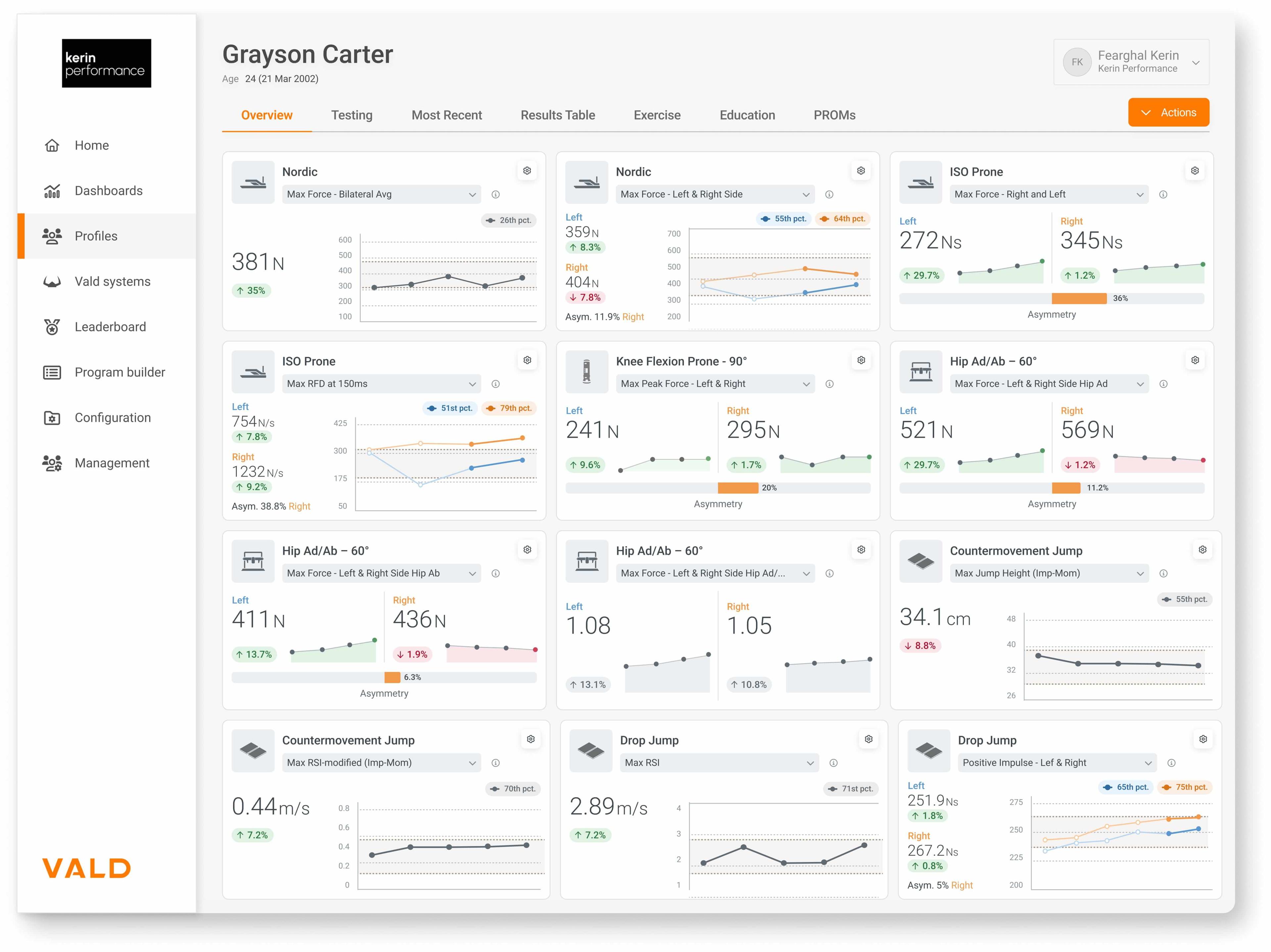
Fearghal’s VALD Hub dashboard highlighting hamstring, lower-limb strength and reactive performance data.
Overview
One of the most common mistakes when managing hamstring injuries is viewing the hamstring as the primary problem. In many cases, the hamstring may simply be the structure absorbing increased load due to unresolved deficits elsewhere.
Previous surgery (e.g., ACL reconstruction), reduced plantar flexor capacity, altered jump strategies, hip weakness and movement compensations can all contribute to increased hamstring loads, especially during high-demand activities like sprinting, jumping and cutting.
Therefore, Fearghal uses this dashboard to combine direct hamstring assessment with broader lower-limb profiling, identifying both local deficits and system-wide contributors.
Nordic

| Test | Metric | Exercise Prescription for Improvement |
 | Peak Force |
|
| Peak Force Asymmetry |
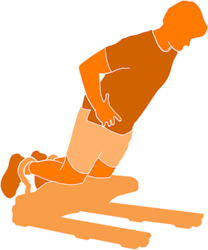
The Nordic serves as Fearghal’s primary assessment of eccentric hamstring capacity, with peak force and asymmetry providing helpful initial clearance measures. However, when interpreting the Nordic, he places equal, if not greater, importance on the force-time curve.
…peak force and asymmetry [are] helpful initial clearance measures. However, when interpreting the Nordic, he places equal, if not greater, importance on the force-time curve.
Athletes with recurrent injuries often demonstrate acceptable peak values while displaying deficits in how force is generated throughout the movement. Force-time curve patterns such as reduced early- and mid-range force production, abrupt drops in force or asymmetrical force-time slopes may indicate unresolved deficits despite seemingly normal strength scores.
For this athlete, Fearghal pays particular attention to mid-range force production given the history of hamstring graft harvest and recurrent medial hamstring symptoms.
Isometric Knee Flexion – Prone (Iso Prone)
| Test | Metric | Exercise Prescription for Improvement |
 | Peak Force |
|
| Peak Force Asymmetry | ||
| Rate of Force Development at 150ms |
|
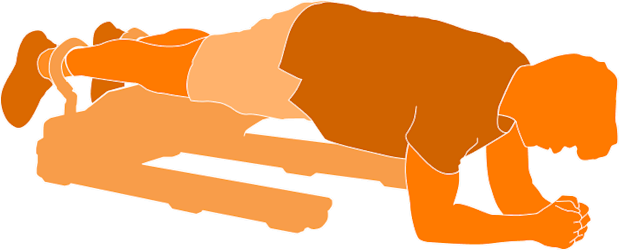
The Iso Prone assessment complements the Nordic by giving Fearghal insight into force production in a static, long-lever position. Athletes can demonstrate different profiles between isometric and eccentric testing, with some performing well in one position while showing substantial deficits in another.
For recurrent hamstring injuries, particularly biceps femoris presentations, this assessment helps him identify whether force deficits persist at longer muscle lengths and guides his exercise selection accordingly.
Athletes can…[perform] well in one position while showing substantial deficits in another.
When deficits are present in both Nordic and Iso Prone assessments, it suggests a broader impairment in hamstring function rather than a limitation in a single strength quality.
Knee Flexion Prone 90°

| Test | Metric | Exercise Prescription for Improvement |
 | Peak Force |
|
| Peak Force Asymmetry |
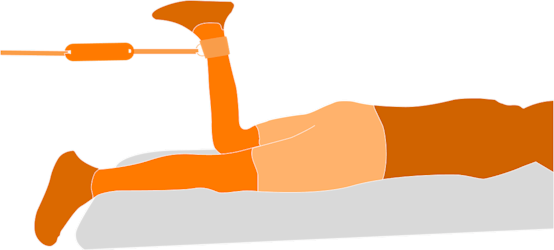
Fearghal uses knee flexion prone 90° testing to identify deficits that may be linked to previous semitendinosus graft harvest, likely due to the relative amount of active insufficiency placed on the hamstrings in this position.
Fearghal uses knee flexion prone 90° testing to identify deficits that may be linked to previous semitendinosus graft harvest…
Athletes who undergo ACL reconstruction with a hamstring graft may return to play safely, with minimal obvious complications. However, persistent short-lever deficits may become apparent after years of playing their sport.
Hip Adduction and Abduction Isometric 60°

| Test | Metric | Exercise Prescription for Improvement |
 | Peak Force Adduction |
|
| Peak Force Abduction |
| |
| Adduction-to-Abduction Ratio |
|
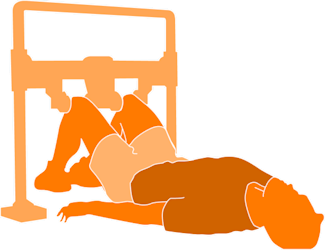
Hip adduction and abduction strength testing allows Fearghal to assess frontal-plane force capacity relevant to pelvic control and sprint mechanics. Peak forces give him insight into absolute strength capacity, while the adduction-to-abduction ratio highlights potential imbalances that may influence load distribution through the hamstrings (Williams et al., 2026). Together, these metrics are useful for monitoring tissue capacity and guiding targeted strengthening strategies.
Hip abduction deficits are also frequently present in athletes with T-junction injuries or other complex hamstring injury histories. Therefore, this assessment helps him identify whether proximal deficits may be contributing to altered running mechanics and increased hamstring demand.
Hip abduction deficits are also frequently present in athletes with T-junction injuries or other complex hamstring injury histories.
Countermovement Jump (CMJ)

| Test | Metric | Exercise Prescription for Improvement |
 | Jump Height |
|
| Reactive Strength Index-Modified |
The CMJ provides Fearghal with a broad overview of lower-body performance. Many athletes with recurrent hamstring injuries maintain excellent jump heights despite ongoing deficits in other areas. As a result, he interprets jump height alongside movement strategy metrics rather than in isolation.
This assessment helps him determine whether overall neuromuscular performance is improving throughout rehabilitation and often serves as a general proxy measure for athlete preparation, especially when preinjury data is available.
The CMJ…often serves as a general proxy measure for athlete preparation, especially when preinjury data is available.
Drop Jump (DJ)
| Test | Metric | Exercise Prescription for Improvement |
 | Reactive Strength Index |
|
| Positive Impulse Asymmetry |
|
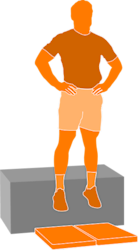
Fearghal often uses the DJ to expose deficits in otherwise high-performing athletes, many of whom exhibit strong force-production capabilities but reduced reactivity. Longer contact times and lower reactive strength scores may indicate an inability to rapidly absorb and reapply force, qualities that are particularly important for field sport athletes returning to sprint exposure.
Longer contact times and lower reactive strength scores may indicate an inability to rapidly absorb and reapply force.
How These Tests Integrate
Rather than relying on a single test or isolated hamstring-strength measure, this dashboard integrates tissue-specific assessment, lower-limb profiling and reactive performance testing to identify both local and global contributors to recurrent injury.
By combining NordBord, DynaMo, ForceFrame and ForceDecks assessments, Fearghal can develop a more complete understanding of the athlete’s movement strategy, force-production capabilities and potential reinjury drivers.
For more insights from Fearghal Kerin on turning objective data into meaningful practice, listen to his interview on VALDCAST.
Interested in building your own dashboard or applying similar methods to complex hamstring rehabilitation and return-to-play decision-making? Get in touch with our team.
References
- Williams, K., van Dyk, N., Winkelman, N., Opar, D., & Williams, M. (2026). Lower limb muscle strength profiles and injury associations: A two-season prospective cohort study in men’s professional rugby union. Journal of Science and Medicine in Sport, 29(5), 492–500. https://doi.org/10.1016/j.jsams.2025.10.012
