My Dashboard: Nicol van Dyk
Available in:
EN
My Dashboard is a series featuring insights from health and performance experts on the tests and metrics they use to identify performance and rehabilitation deficits. Each article includes an optimized VALD Hub dashboard that outlines key tests, metrics and training interventions to help practitioners better integrate testing data into practice.
Contributor

Athlete Profile
A highly rated 22-year-old rugby player who is currently in his first season with a professional team sustained an index hamstring strain injury during mid-season training. Imaging ruled out serious pathology, and there is no history of other significant injuries. He has been referred for rehabilitation to ensure return-to-performance readiness, with the goal of being available for playoff selection in four weeks.
A highly rated 22-year-old rugby player…sustained an index hamstring strain injury during mid-season training …with the goal of being available for playoff selection in four weeks.
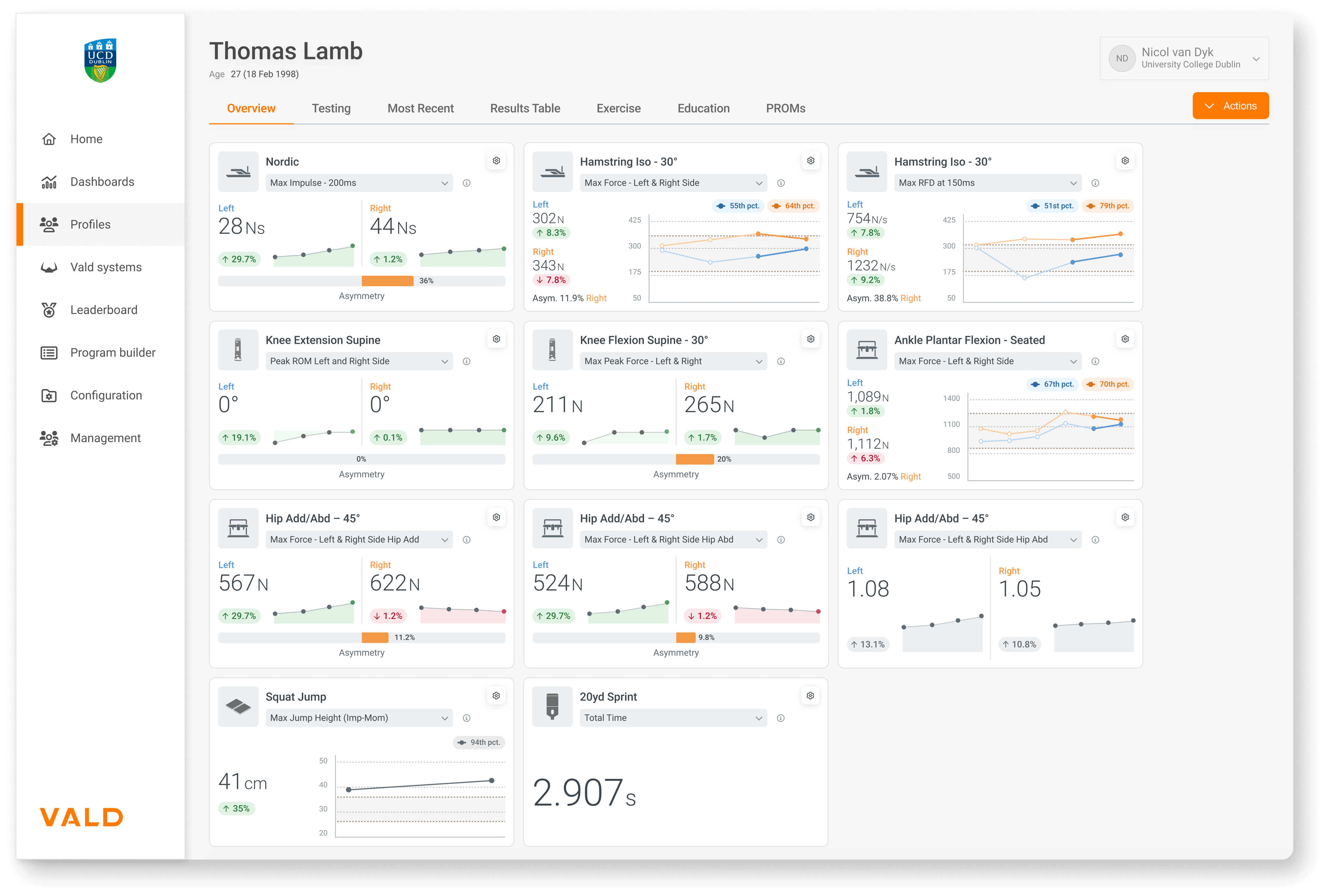
Nicol van Dyk’s VALD Hub dashboard for the injured athlete, highlighting the prioritized tests and metrics used in rehabilitation.
Overview
This dashboard captures key measures across hamstring function, neuromuscular capacity and running performance. Each test provides specific insights into tissue capacity, recovery status or load tolerance, creating a structured system to guide rehabilitation and return-to-performance decision-making.
Nordic

| Test | Metric | Exercise Prescription for Improvement |
 | Peak Force |
|
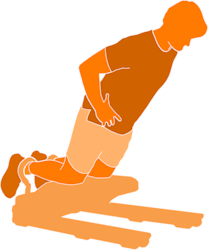
The Nordic provides a direct assessment of eccentric knee-flexor capacity. Peak force reflects the athlete’s ability to control body mass during the eccentric phase and represents the primary indicator of overall hamstring strength during the Nordic.
Higher peak force values indicate greater eccentric force capacity, which is strongly associated with improved resilience to the high loads experienced by the hamstrings during sprinting…
Higher peak force values indicate greater eccentric force capacity, which is strongly associated with improved resilience to the high loads experienced by the hamstrings during sprinting, particularly in the terminal swing phase when the muscles act to decelerate the limb before ground contact.
Tip: Introducing the Nordic earlier in rehabilitation can be beneficial. Evidence suggests the Nordic is safe to perform, can be progressed quickly and may in some cases help restore hamstring activation when pain or apprehension limits isometric performance, particularly when performed bilaterally (Hickey et al., 2017).
Isometric Knee Flexion – 30° (Iso 30)
| Test | Metric | Exercise Prescription for Improvement |
 | Peak Force |
|
| Rate of Force Development (RFD) at 150ms |
|
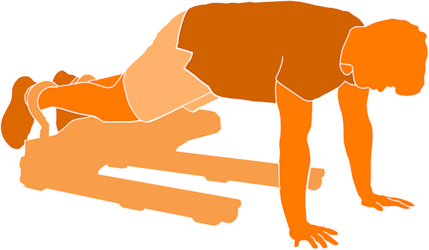
Iso 30 testing assesses hamstring force production at longer levers, aligning more closely with sprint-specific demands than inner-range assessments. Peak force represents outer-range strength capacity, while RFD at 150ms reflects how quickly that force can be expressed. Together, these metrics help indicate readiness for higher-speed running and late-stage rehabilitation loading.
Together, [peak force and RFD] help indicate readiness for higher-speed running and late-stage rehabilitation loading.
Tip: Combining this bilateral isometric test with a unilateral isometric test using ForceFrame or DynaMo can help inform practitioners’ exercise selection and rehabilitation decision-making.
Long-Lever Hip Flexion Range of Motion

| Test | Metric | Exercise Prescription for Improvement |
 | Peak Straight Leg Raise Range of Motion (ROM) |
|
Long-lever hip flexion ROM provides an objective measure of hamstring length tolerance under controlled conditions. Changes in maximal ROM offer insight into tissue irritability and recovery progression, particularly when interpreted alongside pain response. Monitoring ROM trends helps identify whether loading strategies are being tolerated or if regressions are emerging.
Long-lever hip flexion (e.g., straight leg raise) can also be added in a HumanTrak test battery using the Custom Tests feature, enabling practitioners to screen hamstring flexibility quickly and reliably.
Supine Isometric Knee Flexion

| Test | Metric | Exercise Prescription for Improvement |
 | Peak Force |
|
| Peak Force Asymmetry |
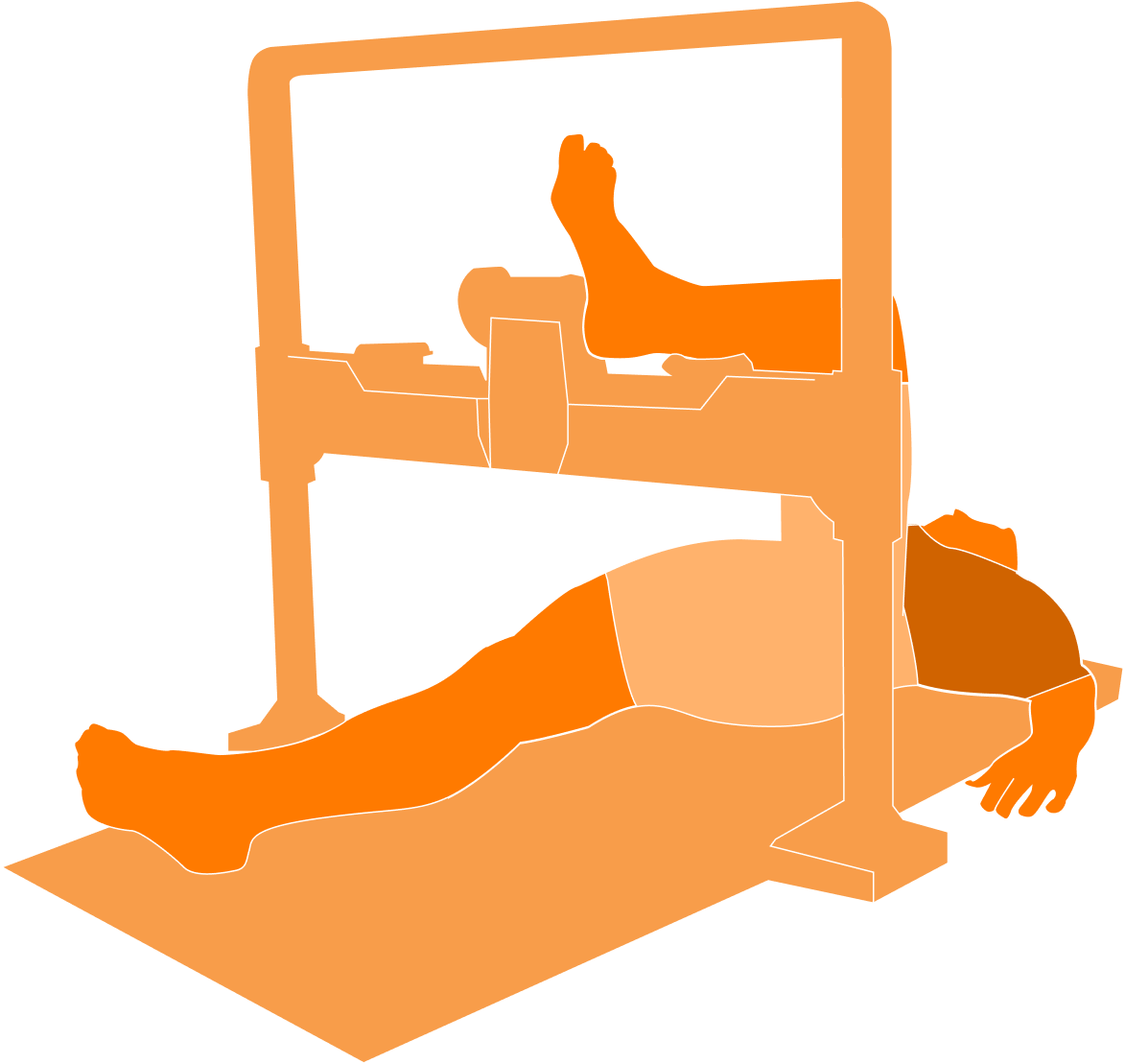
Supine isometric knee flexion testing provides an objective measure of hamstring peak force tolerance in positions that closely resemble maximal velocity sprinting. Changes in peak force offer insight into the recovery of tissue capacity, particularly when interpreted alongside pain response.
Monitoring peak force relative to the uninjured side or the injured limb’s baseline helps determine whether current loading strategies are being tolerated or if signs of regression are emerging, making this test especially useful for guiding rehabilitation progression.
Seated Isometric Calf Raise

| Test | Metric | Exercise Prescription for Improvement |
 | Peak Force |
|
| Peak Force Asymmetry |
The seated isometric calf raise test quantifies calf strength in constrained joint positions, minimizing compensatory strategies. Peak force reflects the maximal force-generating characteristics of the plantar flexors, contributing to sprint performance and ankle stiffness at ground contact. This assessment provides insight into distal force capacity, which may influence hamstring loading during running (Van Dyk & Pecci, 2025).
The seated isometric calf raise test…provides insight into distal force capacity, which may influence hamstring loading during running.
Hip Adduction and Abduction Isometric 60°
| Test | Metric | Exercise Prescription for Improvement |
 | Peak Force Adduction |
|
| Peak Force Abduction |
| |
| Adduction-to-Abduction Ratio |
|
Hip adduction and abduction strength testing assesses frontal-plane force capacity relevant to pelvic control and sprint mechanics. Peak forces offer insight into absolute strength capacity, while the adduction-to-abduction ratio highlights potential imbalances that may influence load distribution through the hamstrings (Williams et al., 2025). These metrics are useful for monitoring tissue capacity and guiding targeted strengthening strategies.
Squat Jump (SJ)
| Test | Metric | Exercise Prescription for Improvement |
 | Jump Height |
|
| Reactive Strength Index-Modified (RSI-Mod) |
|
The SJ isolates concentric force production by removing the countermovement from a jump, minimizing stretch-shortening cycle contribution. Jump height and peak power relative to body mass reflect lower-body concentric output, while RSI-Mod provides insight into the athlete’s jump strategy.
Together, these metrics contextualize global neuromuscular capacity and help determine whether performance changes reflect true force production rather than altered strategy.
Running Progression

| Test | Metric | Exercise Prescription for Improvement |
 | Time (s) Over 20yd Sprint |
|
| Speed (m/s) Over 20yd Sprint* |
|
* Sprint velocity provided in SmartSpeed app, not on VALD Hub.
Running progression is a key component of hamstring rehabilitation. Objective measurement of over-ground running supports accurate progression during end-stage rehabilitation and helps determine whether the athlete is returning to a pre-injury baseline. It also allows for realistic expectation setting when there is a clear goal to return to performance within a fixed window.
[Objective running progression] allows for realistic expectation setting when there is a clear goal to return to performance within a fixed window.
How These Tests Integrate
When combined, these assessments provide a cohesive view of hamstring recovery by linking tissue response, outer-range strength and functional movement capacity. Iso 30, Nordic and supine isometric knee flexion metrics quantify outer-range strength and early force production, both of which underpin capacity for high-speed running, whereas supine straight leg raise ROM provides context around tissue irritability, helping guide interpretation of high-speed running tolerance.
Hip adduction, abduction and plantar flexion isometric assessments complement this process by confirming that the surrounding kinetic chain can support sprinting and jumping demands without placing excessive load on the hamstrings, while SJ metrics provide a global view of neuromuscular output and efficiency.
Finally, objective measures of running progression inform targeted inputs across capacity-building exercises, while the athlete progresses toward higher levels of RFD, speed and acceleration.
While this is not a complete hamstring protocol, it highlights several key evidence-informed objective measures. When viewed together, trends across these measures enable practitioners to progress load and speed exposure with confidence, supporting criteria-based decision-making rather than reliance on isolated test results.
When viewed together, [these] trends…enable practitioners to progress load and speed exposure with confidence…
Interested in building your own dashboard or applying similar methods to hamstring rehabilitation and return to performance? Get in touch with our team.
References
- Hickey, J. T., Timmins, R. G., Maniar, N., Williams, M. D., & Opar, D. A. (2017). Criteria for progressing rehabilitation and determining return-to-play clearance following hamstring strain injury: A systematic review. Sports Medicine, 47(7), 1375–1387. https://doi.org/10.1007/s40279-016-0667-x
- van Dyk, N., & Pecci, J. (2025). May the (horizontal) force be with you: the role of ankle function and horizontal force production on hamstring injury risk and rehabilitation. British Journal of Sports Medicine, 59(19), 1332–1334. https://doi.org/10.1136/bjsports-2024-109485
- Williams, K., van Dyk, N., Winkelman, N., Opar, D., & Williams, M. (2025). Lower limb muscle strength profiles and injury associations: a two-season prospective cohort study in men’s professional rugby union. Journal of Science and Medicine in Sport. S1440-2440(25)00480-3. Advance online publication. https://doi.org/10.1016/j.jsams.2025.10.012
