Return-to-Sport Testing After ACL Reconstruction: Using force plates to assess jump performance and movement strategy

I would like to thank my colleagues and contributors, Maxime Gaspar, Jean Bouvet and Paul Rigaudeau, for their expertise and contributions to this article.
Return-to-sport testing after anterior cruciate ligament (ACL) reconstruction has shifted from time-based milestones to criteria-based assessments (Dingenen & Gokeler, 2017). However, many athletes still do not regain their pre-injury level of function or performance (Ardern et al., 2014).
At the French Football Federation’s Clairefontaine Medical Centre, we use the 11-to-Perf battery to assess footballers before they return to team training. It combines physical, psychological and neuromuscular measures, including ForceDecks jump testing to evaluate force production, stretch-shortening cycle (SSC) function and movement strategy, not just jump height.
Introducing Jump Testing After ACL Reconstruction
Although commonly associated with late-stage rehabilitation, bilateral countermovement jump (CMJ) testing using force plate technology such as ForceDecks may be introduced earlier when appropriate clinical criteria are met. At Clairefontaine, we typically begin testing 3-4 months following ACL reconstruction, depending on the athlete’s clinical presentation and progression.
…bilateral CMJ testing…may be introduced earlier when appropriate clinical criteria are met.
Before introducing maximal jump assessments, our practitioners evaluate several criteria:
- Symptoms: Absence of pain and joint effusion during loading.
- Range of Motion: Restoration of full, symmetrical knee range of motion.
- Strength: Sufficient lower-limb strength to tolerate jumping.
- Movement Competency: Appropriate control during squatting and landing tasks.
- Loading Tolerance: Successful progression through strengthening and low-intensity plyometrics.
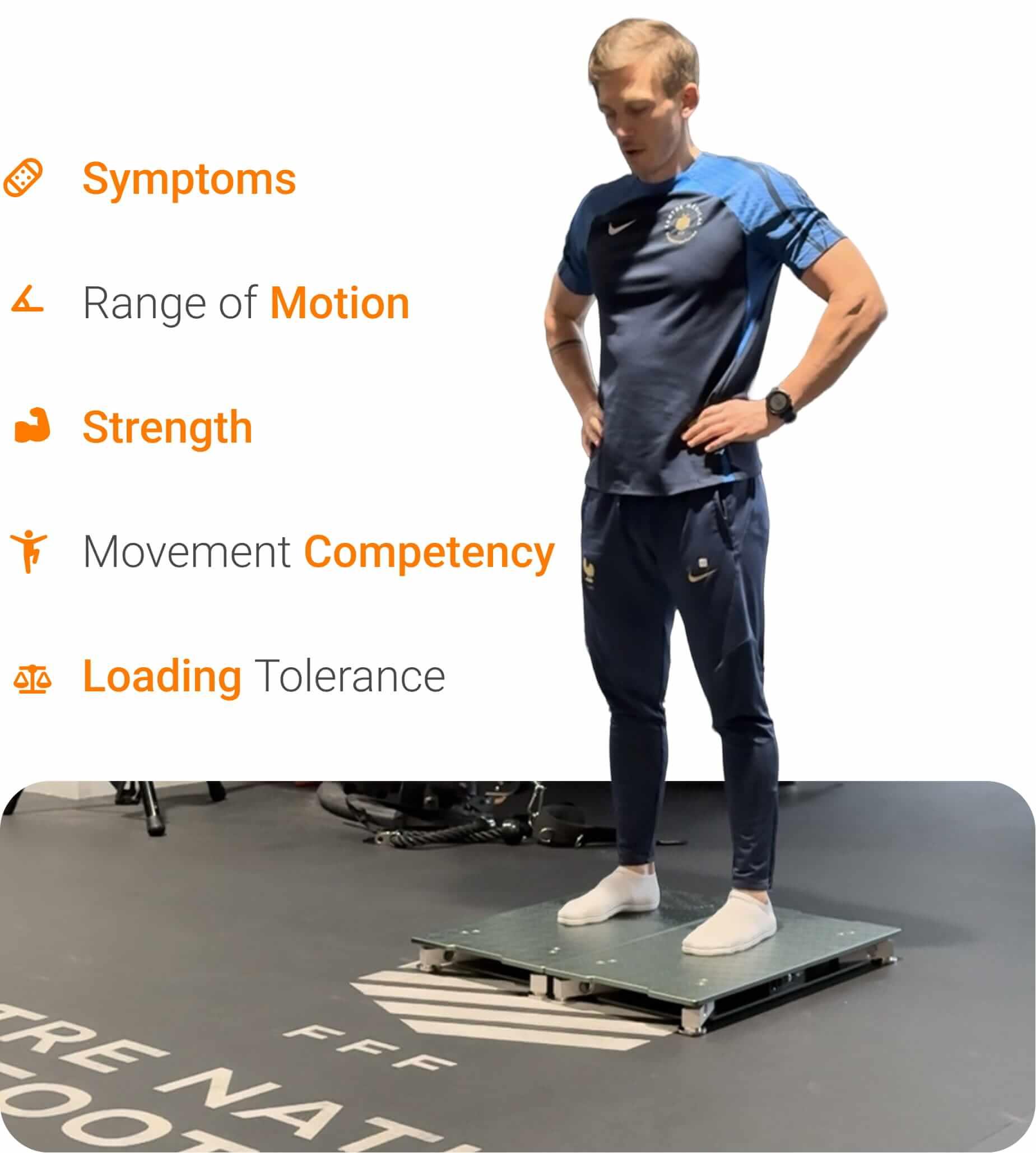
These criteria align with recommendations for progressively reintroducing plyometrics following ACL reconstruction (Buckthorpe & Della Villa, 2021). Progression toward maximal jumping should account for increasing eccentric loading, movement velocity and SSC demands. Results should also be interpreted alongside strength testing, unilateral movement assessments and psychological readiness measures such as the ACL-RSI.
Standardizing the Warm-Up
Before completing the jump testing battery, athletes undergo a standardized warm-up and familiarization protocol. At Clairefontaine, this includes:
- Cycling: Five minutes at approximately 1.5W/kg.
- Horizontal Leg Press: Three sets of five bilateral repetitions at a load equivalent to body weight (BW), with high intent to maximize power.
- CMJ Familiarization: Five bilateral CMJs assisted by an elastic band.
This progression prepares athletes for the mechanical demands of jumping while allowing practitioners to assess movement competency and tolerance before testing.
Assessing Jump Performance with ForceDecks
At Clairefontaine, we use CMJs and single leg jumps to assess lower-limb neuromuscular performance. While jump height provides an indication of overall performance, ForceDecks enables our practitioners to examine the underlying force-time characteristics and identify altered movement strategies or compensations that may persist following ACL reconstruction.
…ForceDecks enables our practitioners to examine the underlying force-time characteristics and identify altered movement strategies or compensations that may persist following ACL reconstruction.
Establishing Valid and Repeatable Trials
Athletes complete a minimum of three CMJ trials, and we use an eccentric peak velocity (EPV) threshold of less than −1.2m/s to assess countermovement execution. If this criterion is met and jump height continues to improve, additional repetitions are completed until performance plateaus or declines.
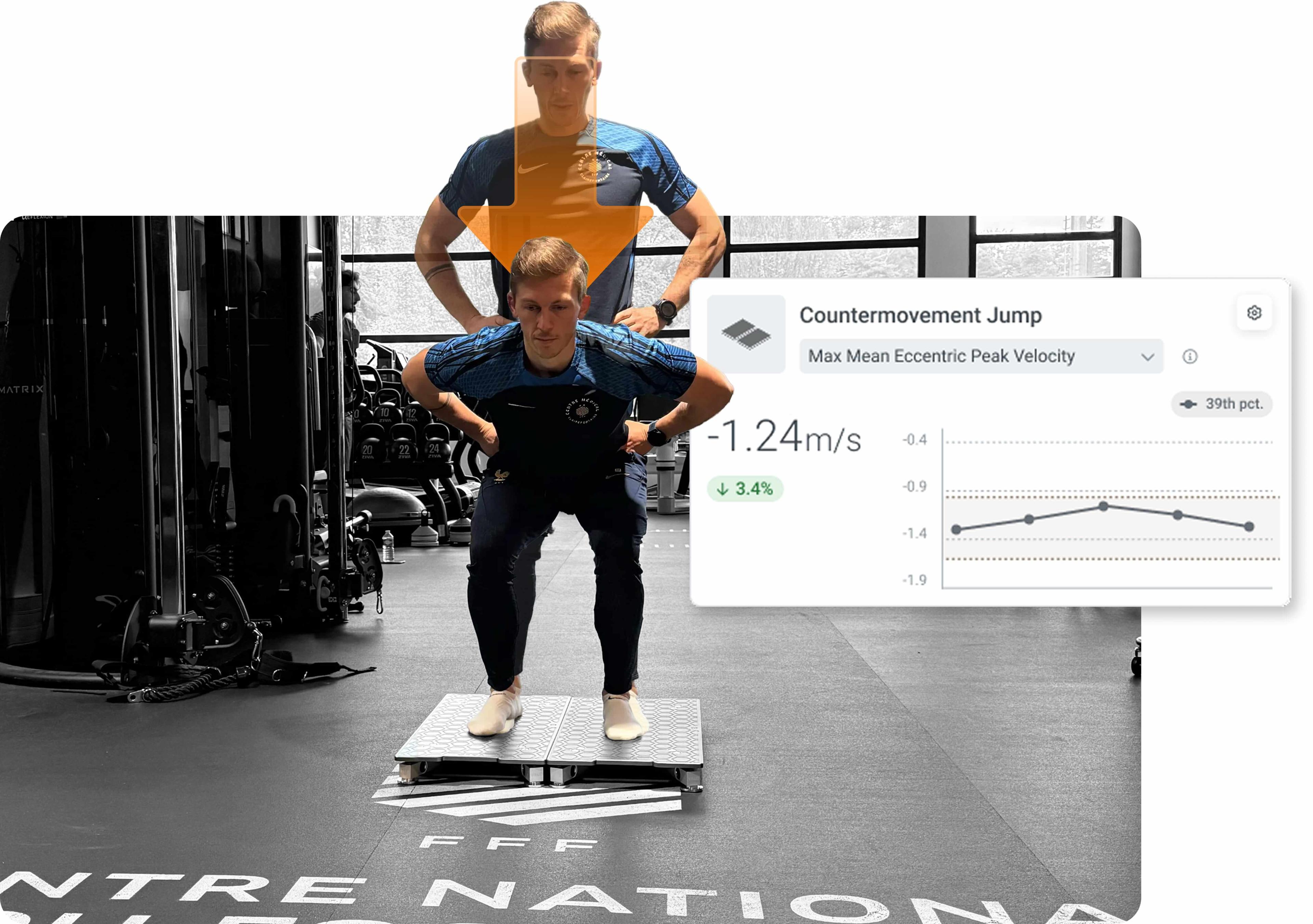
For analysis, our practitioners select the trial meeting the EPV threshold with the highest reactive strength index-modified (RSI-Mod). If no trial meets the threshold, the trial with the best available EPV is retained. This approach helps distinguish performance limitations from differences in test execution, although the −1.2m/s threshold is specific to Clairefontaine’s protocol rather than a universal CMJ requirement.
Understanding the Four Phases of CMJ Performance
At Clairefontaine, we divide CMJ analysis into four components to assess neuromuscular performance and movement strategy:
- Initiation: Unloading and controlling the countermovement.
- Force Transfer: Transitioning from eccentric braking to concentric propulsion.
- Concentric Power: Generating force and power during takeoff.
- Performance Outcome: Evaluating jump height and overall performance.
1. Initiation
In our approach, the initiation encompasses both the unloading and yielding phases of the CMJ, from movement onset to EPV. Together, these phases describe how the athlete reduces vertical force to initiate the countermovement and accelerates downward before braking. ForceDecks enables practitioners to assess these characteristics and identify potential alterations in movement strategy following ACL reconstruction. Three metrics are particularly relevant:
| Metric | What It Measures | Potential Clinical Interpretation |
| Minimum Eccentric Force | Lowest vertical force during initial unloading | Limited unloading may indicate a cautious or protective movement strategy |
| EPV | Maximum downward velocity during the countermovement | Lower velocity may reflect difficulty rapidly initiating or controlling the descent |
| Countermovement Depth | Vertical displacement during the countermovement | Reduced depth may indicate movement restrictions, altered strategy or reduced loading tolerance |
Following ACL reconstruction, reduced unloading, slower descent or shallower countermovement depth may indicate protective movement strategies, potentially influenced by apprehension, strength deficits or altered motor control.
…reduced unloading, slower descent or shallower countermovement depth may indicate protective movement strategies…
For more information on the unloading and yielding phases of the CMJ and their associated metrics, read the Introducing the Yielding Phase and New Metrics in ForceDecks article.

2. Force Transfer
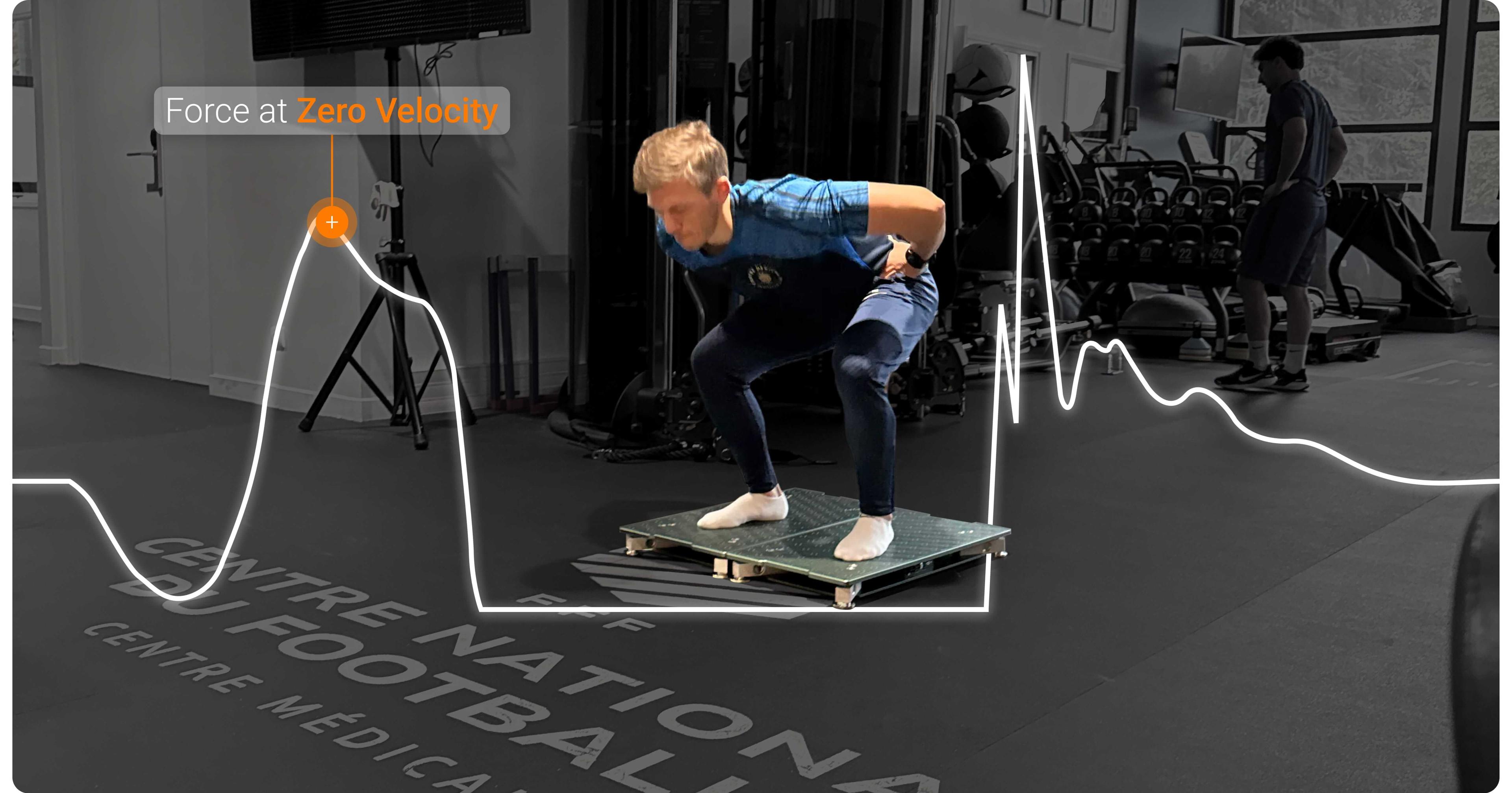
Following the unloading and yielding phases, athletes must rapidly decelerate their downward momentum before transitioning into the concentric phase. Force at zero velocity represents the vertical force produced at this transition, providing a consistent reference point for assessing force production between the eccentric and concentric phases.
For example, high EPV combined with low force at zero velocity may indicate difficulty decelerating the downward movement. Conversely, a slower descent may reduce braking demands and potentially mask eccentric force-production deficits.
…high EPV combined with low force at zero velocity may indicate difficulty decelerating the downward movement.
Force at zero velocity should therefore be interpreted alongside EPV, countermovement depth and other braking metrics. Monitoring these variables over time may help identify changes in movement strategy, although their independent clinical significance requires further investigation.
The main question we ask is whether the highest force reached across the entire takeoff phase is the same as the force at zero velocity. In practice, we treat the two values as essentially equal if they are within about 1% of each other and then check the force-time curve to confirm where the peak occurs.
If the peak coincides with zero velocity, the athlete reaches their highest force right at the transition from braking to propulsion. We see that as a potential sign of effective use of the SSC. If the peak occurs earlier in the eccentric phase or later in the concentric phase, we look more closely at what might explain that strategy, including how the athlete coordinates the eccentric and concentric phases.
3. Concentric Power
Following the eccentric-concentric transition, athletes must generate sufficient force and impulse to accelerate their center of mass vertically. Three complementary metrics provide insight into concentric performance:
| Metric | What It Measures | Clinical Application |
| Concentric Peak Force | Maximum force during propulsion | Assesses peak force production, with interpretation influenced by when the peak occurs. |
| Concentric Peak Power | Maximum mechanical power during propulsion | Reflects the ability to produce force at velocity. |
| Concentric Impulse | Total force-time contribution during propulsion | Reflects the ability to generate and sustain force throughout propulsion. |
Concentric peak force requires additional context, as athletes may achieve similar peak values at different points during propulsion. For example, peak force may occur immediately after the eccentric-concentric transition or later in the concentric phase, reflecting different force-production strategies.
Concentric peak power and concentric impulse provide complementary information about power generation and sustained force production, helping practitioners identify potential limitations contributing to reduced jump performance.
4. Performance Outcome
The final component evaluates jump performance using two primary metrics:
- Jump Height (Impulse-Momentum): Estimates jump height from the net vertical impulse generated during takeoff.
- RSI-Mod: Relates jump height to contraction time, reflecting performance relative to movement duration.
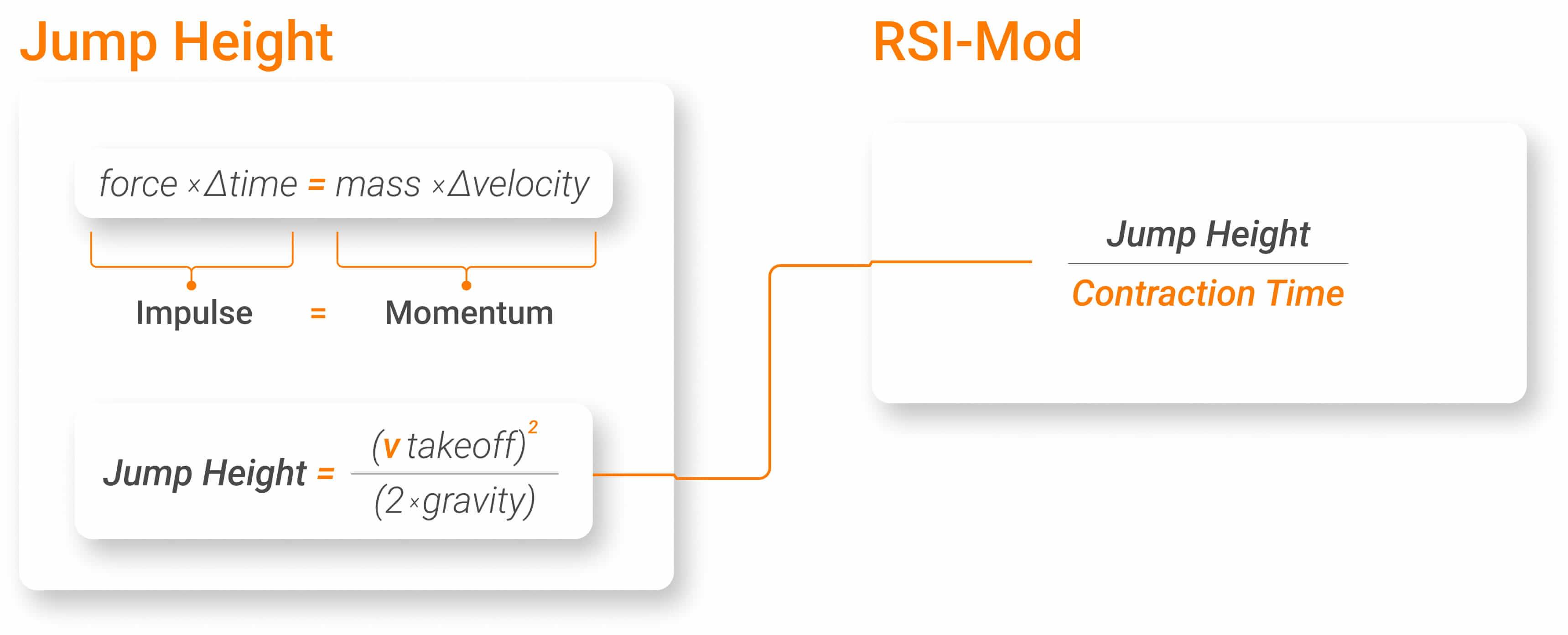
While useful for monitoring rehabilitation progress, these metrics do not fully explain how performance is achieved. For example, an athlete may restore jump height through increased concentric impulse while retaining reduced EPV or altered braking mechanics. Improved jump height does not necessarily indicate that all neuromuscular deficits have resolved.
Improved jump height does not necessarily indicate that all neuromuscular deficits have resolved.
Distinguishing Performance from Movement Strategy
Distinguishing between what an athlete produces and how they produce it is particularly valuable during rehabilitation. Athletes may achieve similar jump heights through different combinations of countermovement depth, EPV, braking force and concentric impulse.
Likewise, jump height may improve without corresponding changes in unloading or braking characteristics. Interpreting these metrics together helps practitioners identify potential limitations, monitor changes in movement strategy and guide subsequent rehabilitation decisions.
Two Families of Variables
Performance: What the Athlete Produces
Performance variables reflect the athlete’s mechanical capacities.
| Variable | What It Measures | Interpretation and Precautions |
| Jump Height (Impulse-Momentum) | Jump outcome, from integrated vertical force | Should not be compared to other means of measuring jump height (e.g., jump mat). Does not provide a measure of jump strategy. |
| Concentric Peak Force / BW | Peak propulsive force relative to BW | Compared with force at zero velocity to understand jump strategy and force production timing. |
| Concentric Peak Power | Peak concentric power | Provides a measure of athlete explosiveness. |
| Concentric Peak Velocity | Peak center-of-mass velocity during propulsion | Determines jump height and provides a measure of acceleration efficiency. |
| Concentric Impulse | Force integral up to takeoff | Compared with force at zero velocity to determine jump strategy. |
| RSI-Mod | Jump height / contraction time | Summary of neuromuscular efficiency. |
Motor Strategy: How the Athlete Produces It
Motor strategy variables explain how performance is produced, including countermovement quality, SSC use and the transfer into propulsion.
| Variable | What It Measures | Interpretation and Precautions |
| Minimum Eccentric Force | Lowest force during unweighting | If minimum force is high, it indicates a poor unloading strategy that may reflect excessive caution during the jump. |
| EPV | Peak downward velocity | Common criterion for ACL athletes used to reflect a better initiation strategy and helps provide a proxy measure for deceleration ability. |
| Countermovement Depth | Countermovement amplitude | Key indicator of jump strategy, provides an understanding of stiff vs. compliant jump performance. Commonly compared with other metrics like force at zero velocity. |
| Force at Zero Velocity | Force when center-of-mass velocity reaches zero (braking to propulsion) | Reflects braking-to-propulsion transfer, assessed session to session and in comparison to other metrics. |
| Contraction Time | Movement onset to takeoff | Used to compare with RSI-Mod. |
These metrics guide clinical reasoning; they do not diagnose specific impairments. Low EPV may reflect weakness, apprehension or an altered movement strategy indicative of incomplete performance recovery. Isometric testing systems, such as ForceFrame or DynaMo, can be used to assess the extent of recovery of specific qualities, including maximum force, rate of force development and range of motion.
Integrating Jump Testing into Return-to-Sport Decision-Making
Force plate testing goes beyond jump height, revealing movement strategies and neuromuscular limitations that can persist despite improved performance. However, the CMJ is only one component of return-to-sport assessment and should not be interpreted in isolation.
Following ACL reconstruction, Clairefontaine’s 11-to-Perf battery combines bilateral and unilateral jumps, reactive strength and measures of physical and psychological readiness. The aim is not to conduct more tests, but to use complementary assessments that are monitored over time and interpreted in context.
If you are interested in learning how ForceDecks can support ACL rehabilitation and return-to-sport testing in your practice, get in touch with our team.
References
- Ardern, C. L., Taylor, N. F., Feller, J. A., & Webster, K. E. (2014). Fifty-five per cent return to competitive sport following anterior cruciate ligament reconstruction surgery: An updated systematic review and meta-analysis including aspects of physical functioning and contextual factors. British Journal of Sports Medicine, 48(21), 1543–1552. https://doi.org/10.1136/bjsports-2013-093398
- Buckthorpe, M., & Della Villa, F. (2021). Recommendations for plyometric training after ACL reconstruction - A clinical commentary. International Journal of Sports Physical Therapy, 16(3), 879–895. https://doi.org/10.26603/001c.23549
- Dingenen, B., & Gokeler, A. (2017). Optimization of the return-to-sport paradigm after anterior cruciate ligament reconstruction: A critical step back to move forward. Sports Medicine, 47(8), 1487–1500. https://doi.org/10.1007/s40279-017-0674-6
- Disegni, E., Memain, G., Bouvet, J., Gaspar, M., Maille, R., Tamalet, B., Orhant, E., Maille, P., Bohu, Y., & Hardy, A. (2025). The “11 to Perf Score”, a test for professional players returning to soccer after anterior cruciate ligament reconstruction. Journal of Clinical Medicine, 14(1), 11. https://doi.org/10.3390/jcm14010011
