Seasonal Kinematic Profiling in Female High School Athletics
Available in:
EN

This case study forms part of the Practitioner’s Guide to Movement Analysis and explores how seasonal kinematic profiling can reveal team-level adaptations, contextualize movement data and inform interdisciplinary decision-making in female high school athletics.
Hospital for Special Surgery Athlete Health developed the Move Better Lab in response to the high prevalence of lower-extremity injuries in sport. Data from the National Collegiate Athletic Association (NCAA) and the International Journal of Environmental Research and Public Health (IJERPH) indicate that these injuries account for more than half of reported cases across collegiate and youth athletics (Kelley et al., 2023).
Given this epidemiology, the screening framework prioritized movement patterns associated with non-contact knee and ankle injury risk, including dynamic knee valgus, inter-limb asymmetry and landing force characteristics.
Assessment Framework
Movement quality was defined as the ability to safely and efficiently perform foundational tasks such as running, jumping and changing direction. A standardized multi-test battery was implemented across all individuals.
Force plates, such as ForceDecks, were used to quantify force-time characteristics during jumping and landing tasks, while markerless motion capture systems, such as HumanTrak, were used to quantify joint kinematics during squatting and single leg tasks. This approach allowed kinetic and kinematic variables to be interpreted together rather than in isolation.
This approach allowed kinetic and kinematic variables to be interpreted together rather than in isolation.
In this case, emphasis was placed on the single leg squat, with the peak frontal-plane knee angle at peak knee flexion selected as the primary variable of interest.
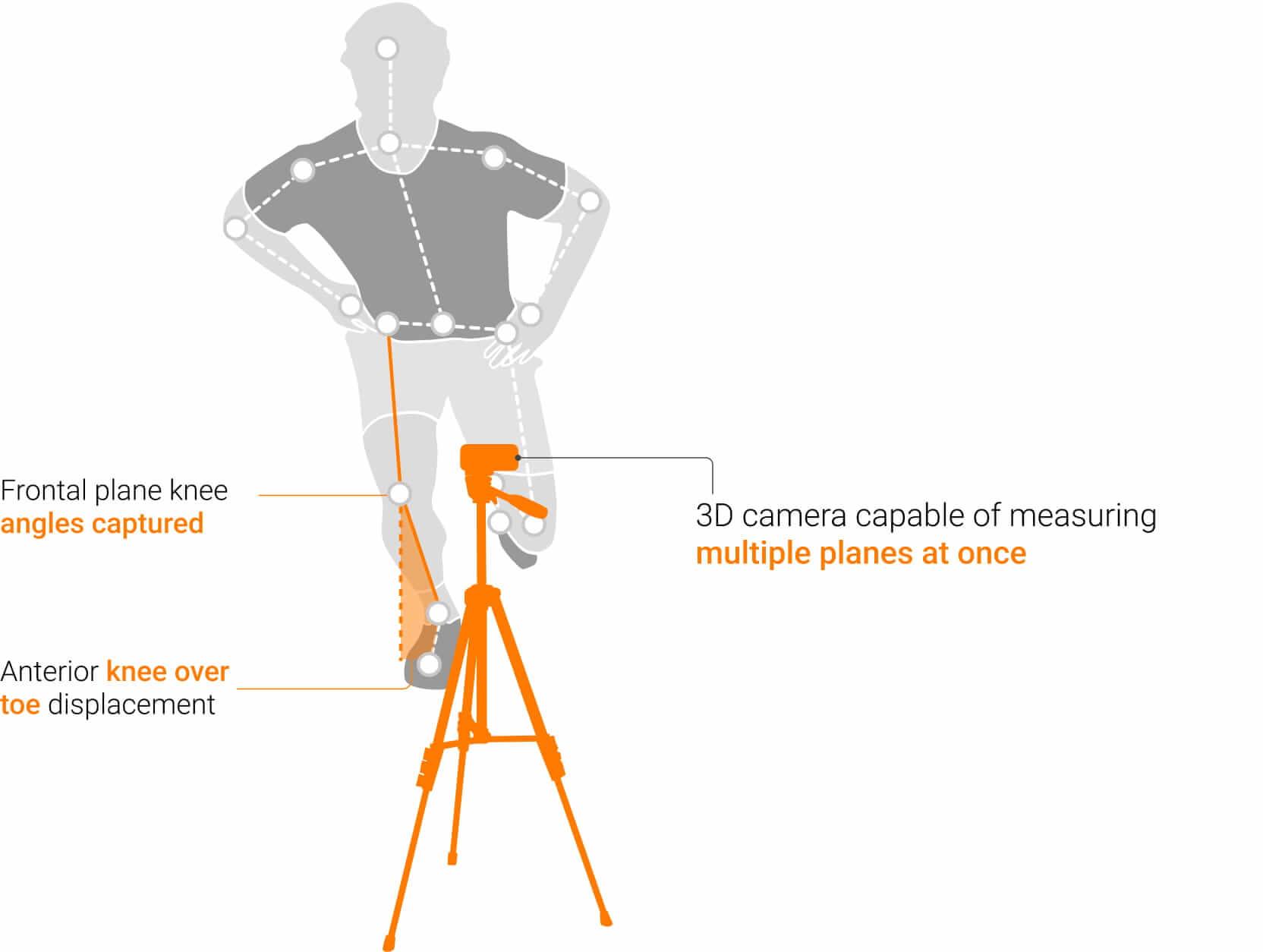
HumanTrak used to quantify frontal-plane knee angle during a single leg squat.
Baseline Findings
Two girls’ teams from the same high school, basketball and track and field, were assessed pre- and post-season. Both sports involve frequent single leg landings and rapid changes of direction, and both groups carry an elevated risk of non-contact anterior cruciate ligament (ACL) injury compared with males.
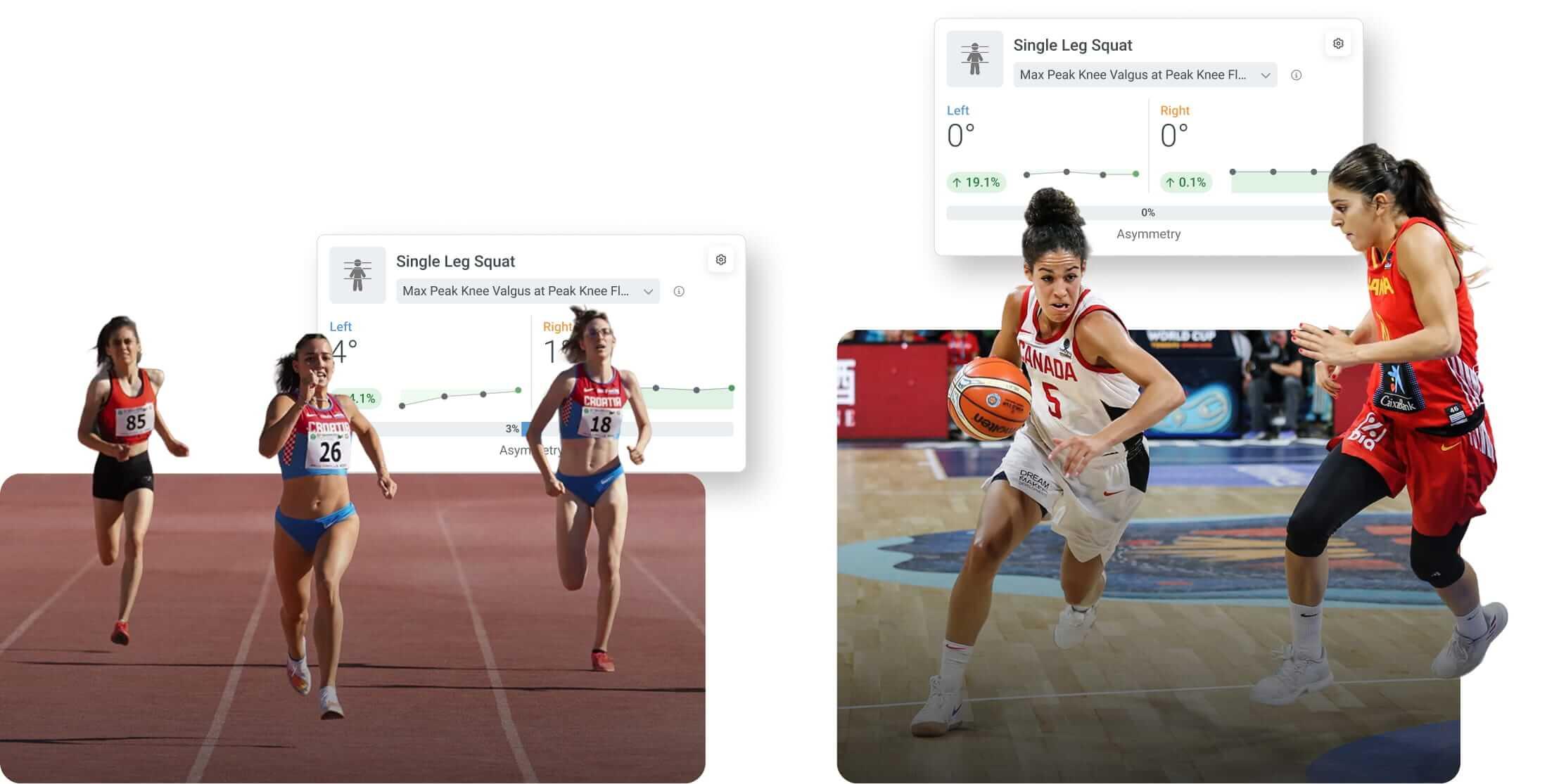
Preseason testing demonstrated that most individuals across both teams exhibited 4-5° of dynamic knee valgus at peak knee flexion during the single leg squat. This established a standardized baseline for seasonal comparison and enabled team-level profiling.
Preseason testing demonstrated that most individuals…exhibited 4-5° of dynamic knee valgus at peak knee flexion during the single leg squat.
Reassessment and Interpretation
Post-season testing revealed divergent adaptations between teams. In basketball, individuals demonstrated reduced peak knee valgus and improved single leg squat control. In contrast, track and field showed minimal change in frontal-plane knee mechanics over the same period.
These findings prompted an interdisciplinary review with sport coaches, strength staff and athletic trainers. Differences in structured neuromuscular warm-ups and load management practices emerged as likely contributors to the discrepancy. The basketball program consistently implemented dynamic neuromuscular preparation, while the track and field program demonstrated less structured exposure.
From a decision-making standpoint, the findings highlighted the following:
- Objective motion data collected under a standardized protocol can reveal program-level adaptations that observation alone would miss.
- Knee valgus magnitude should not be interpreted as a standalone injury predictor.
- Movement metrics must be contextualized within exposure, loading patterns and sport demands.
- Seasonal comparison enables identification of coaching or programming effects rather than performance-related assumptions.
Objective motion data collected under a standardized protocol can reveal program-level adaptations that observation alone would miss.
Practical Application
This case reinforces that standardized movement screening enables meaningful comparison across teams and time points, while multi-modal assessment integrating force-time and joint kinematic data provides greater context than observation alone. Seasonal retesting within a structured decision-making framework supports objective communication between medical and performance staff and informs targeted injury prevention strategies.
Seasonal retesting within a structured decision-making framework supports objective communication…and informs targeted injury prevention strategies.
To learn more about using objective movement analysis to profile movement patterns, monitor seasonal changes and inform injury prevention strategies, explore our Practitioner’s Guide to Movement Analysis or get in touch.
References
- Kelley, E. A., Hogg, J. A., Gao, L., Waxman, J. P., & Shultz, S. J. (2023). Demographic factors and instantaneous lower extremity injury occurrence in a National Collegiate Athletic Association Division I population. Journal of Athletic Training, 58(5), 393–400. https://doi.org/10.4085/1062-6050-0673.21
