Morgan Williams is a Data Scientist at VALD, Adjunct Associate Professor at Griffith University and an external affiliate member of the Australian Centre for Precision Health and Technology (PRECISE).
Morgan WilliamsPhD, FHEA, CSCS
Available in:
EN
Morgan Williams is a Data Scientist at VALD, Adjunct Associate Professor at Griffith University and an external affiliate member of the Australian Centre for Precision Health and Technology (PRECISE).
Matt Bourne is an Associate Professor and Principal Research Fellow at Griffith University and spearheads the Precision Athlete research program at PRECISE.

Morgan Williams is a Data Scientist at VALD, Adjunct Associate Professor at Griffith University and an external affiliate member of the Australian Centre for Precision Health and Technology (PRECISE).

Matt Bourne is an Associate Professor and Principal Research Fellow at Griffith University and spearheads the Precision Athlete research program at PRECISE.
This is Part 1 of our Understanding the Nordic Hamstring Exercise series. This article covers the background, setup and execution of the Nordic hamstring exercise (NHE), including its role in performance enhancement and injury risk reduction, key coaching strategies, common technical faults and practical ways to improve training adherence.
The NHE, also known as the Nordic hamstring curl, Russian leg curl, inverse leg curl or natural glute-ham raise, is a fundamental component of hamstring injury prevention and performance programs. Meta-analyses of nearly 8,500 athletes found that injury prevention programs including the NHE reduce hamstring injury risk by more than 50% (van Dyk et al., 2019).
As early as 1880, the NHE was recognized for its benefits in addressing specific physical weaknesses.
As early as 1880, the NHE was recognized for its benefits in addressing specific physical weaknesses (Taylor, 1880). Today, backed by extensive research, this simple yet highly effective exercise has become a staple in the routines of top athletes and fitness enthusiasts worldwide. With systems such as NordBord capable of measuring NHE performance, practitioners now use the exercise not only for training but as a reliable method for monitoring and testing.
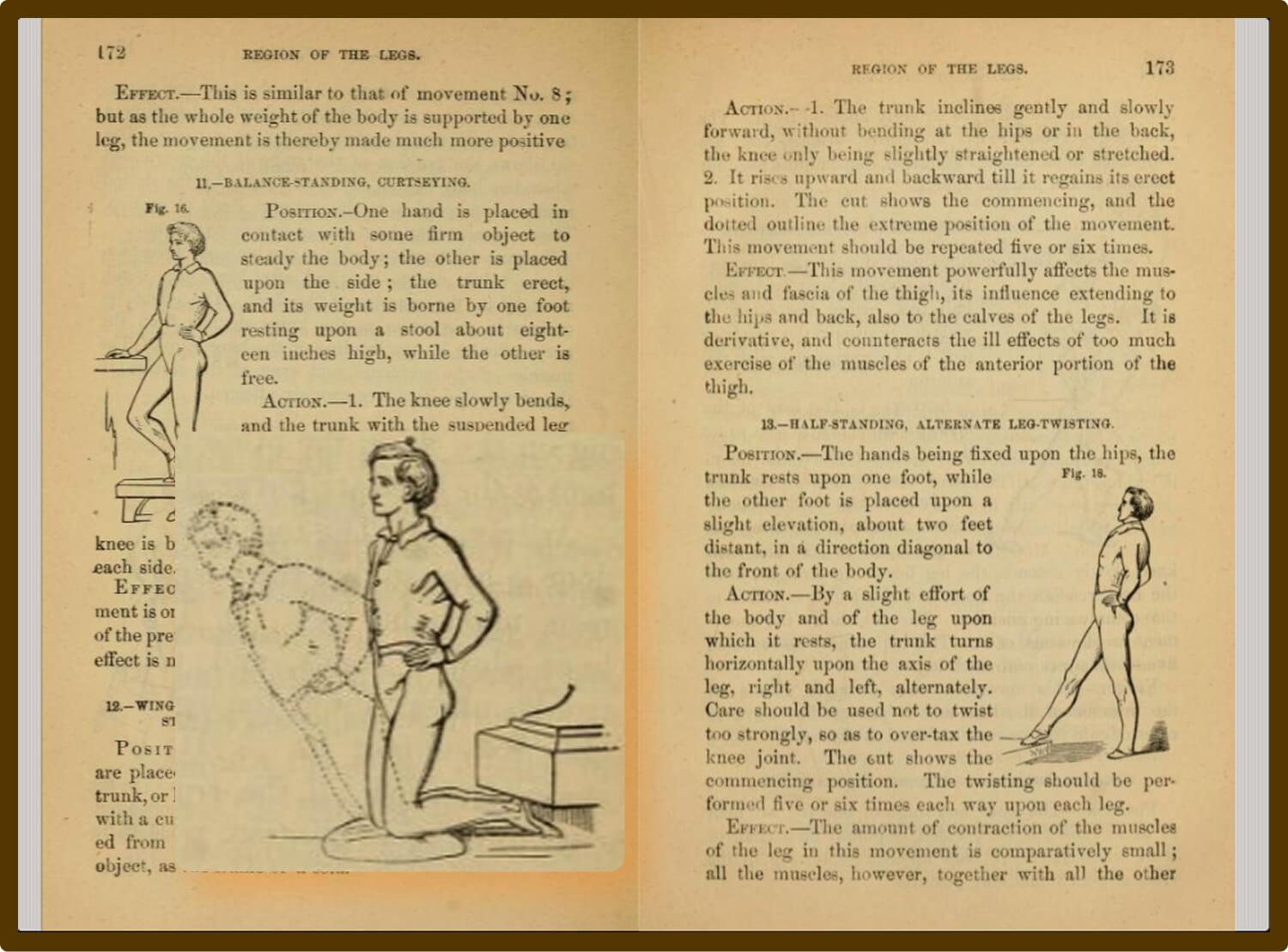
Excerpt from Health by Exercise, an early guide to using targeted movement to address physical weaknesses (Taylor, 1880).
The NHE uses an athlete’s body mass to load the hamstrings eccentrically and can be performed with no equipment. Its simplicity makes it highly adaptable, suitable for nearly any setting and for athletes of all ages and training levels.
Key adaptations from NHE training include eccentric strengthening of the knee flexors and lengthening of biceps femoris long head fascicles, among other secondary and tertiary adaptations (Bourne et al., 2018).
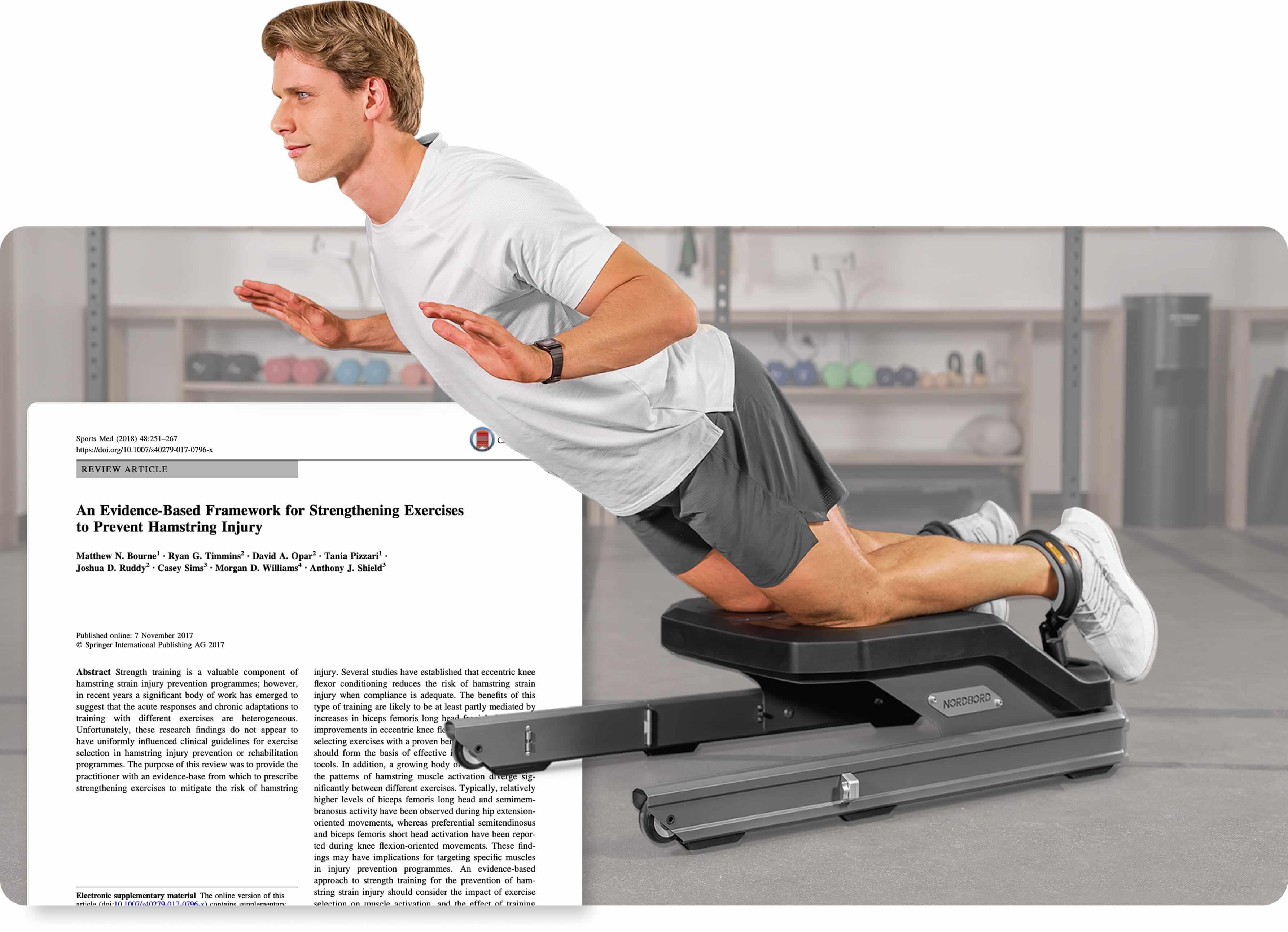
…the NHE has become a cornerstone of research-backed injury prevention programs…
With its ease of implementation, proven performance benefits and strong evidence for reducing hamstring injury risk, the NHE has become a cornerstone of research-backed injury prevention programs, including:
Although the NHE is commonly included in injury prevention programs, compliance can be a challenge. One barrier is the high level of voluntary effort required to resist forward movement. This demand can initially be perceived as uncomfortable, particularly for athletes new to the exercise.
Another consideration is delayed onset muscle soreness (DOMS), which typically peaks two days after the initial session. While often viewed negatively, this response reflects protective adaptations associated with the repeated-bout effect, whereby subsequent exposures result in markedly less soreness and muscle damage (McHugh, 2003).
While often viewed negatively, [DOMS] reflects protective adaptations associated with the repeated-bout effect, whereby subsequent exposures result in markedly less soreness and muscle damage.
Performing the movement passively and falling forward without maintaining sufficient tension may reduce discomfort, but it fails to elicit the mechanical stimulus necessary for meaningful adaptation. Accordingly, practitioners should ensure athletes are appropriately prepared and instructed to execute the NHE with adequate intent and control.
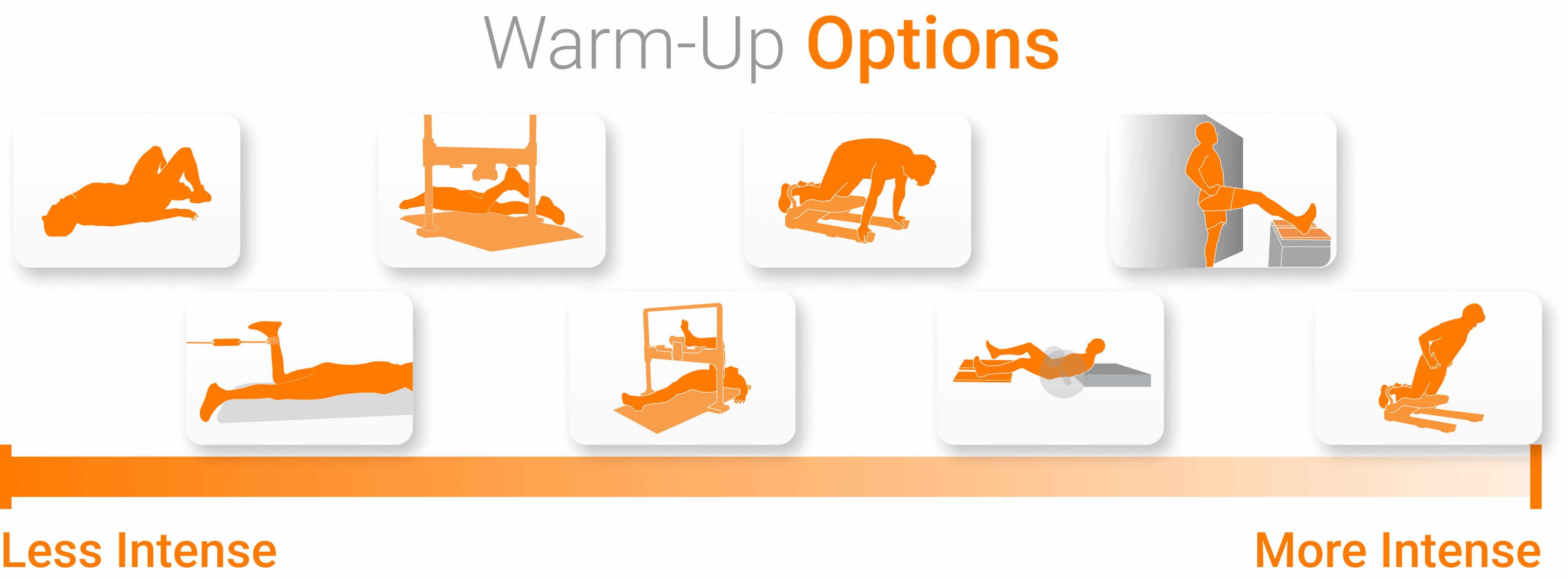
Warming up before performing the NHE helps prepare the athlete for the required intensity. Recommended warm-up options include:
Below is the preferred setup to perform the NHE:
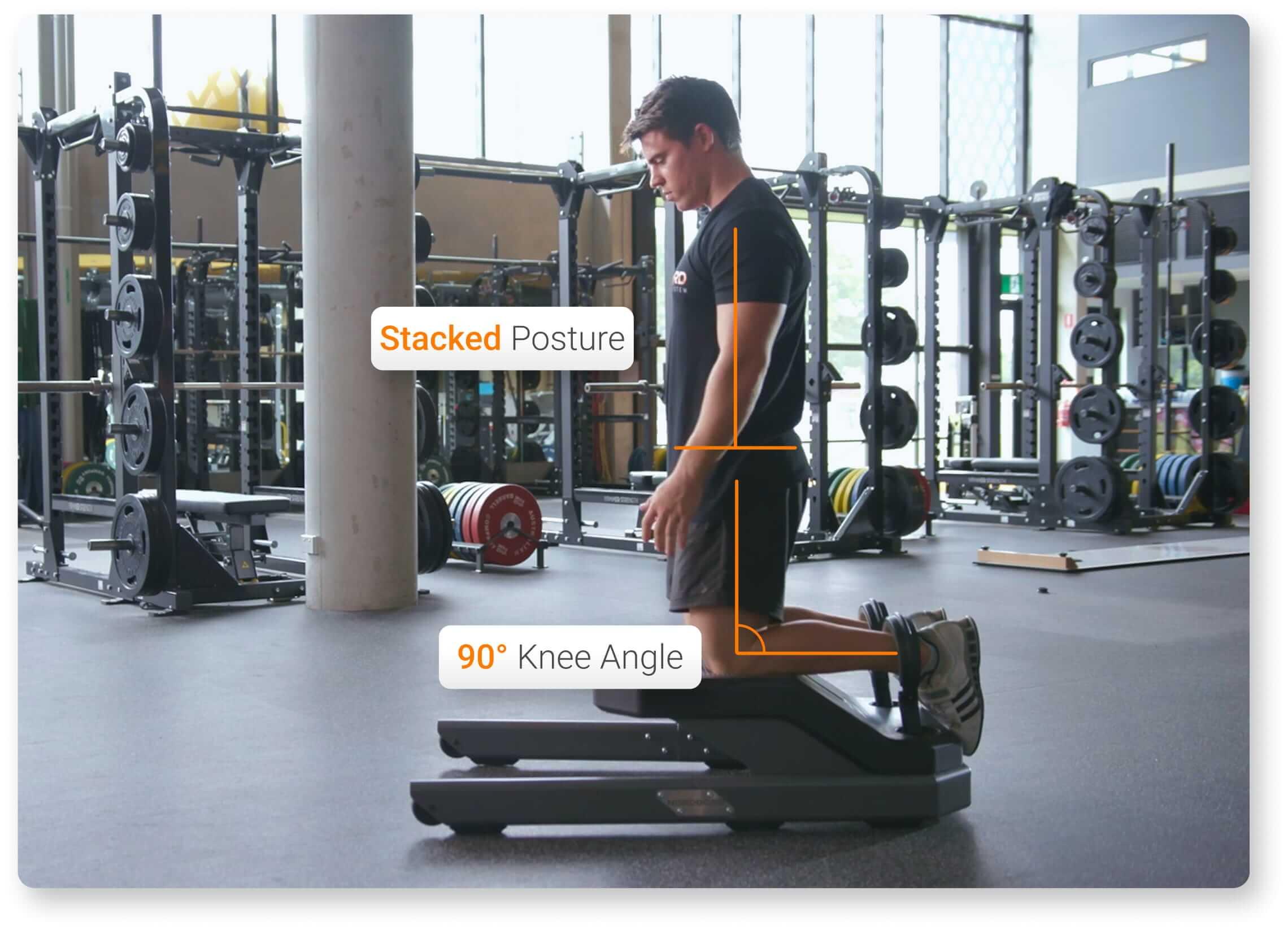
A key factor underpinning its effectiveness is the progressively increasing knee-flexion moment arm as the athlete leans forward, which systematically increases eccentric demand on the hamstrings.
This rising mechanical challenge requires high levels of eccentric loading at long muscle lengths, making the exercise both time-efficient and potent when executed with appropriate intent and control.
…rising mechanical challenge [of the NHE] requires high levels of eccentric loading at long muscle lengths…
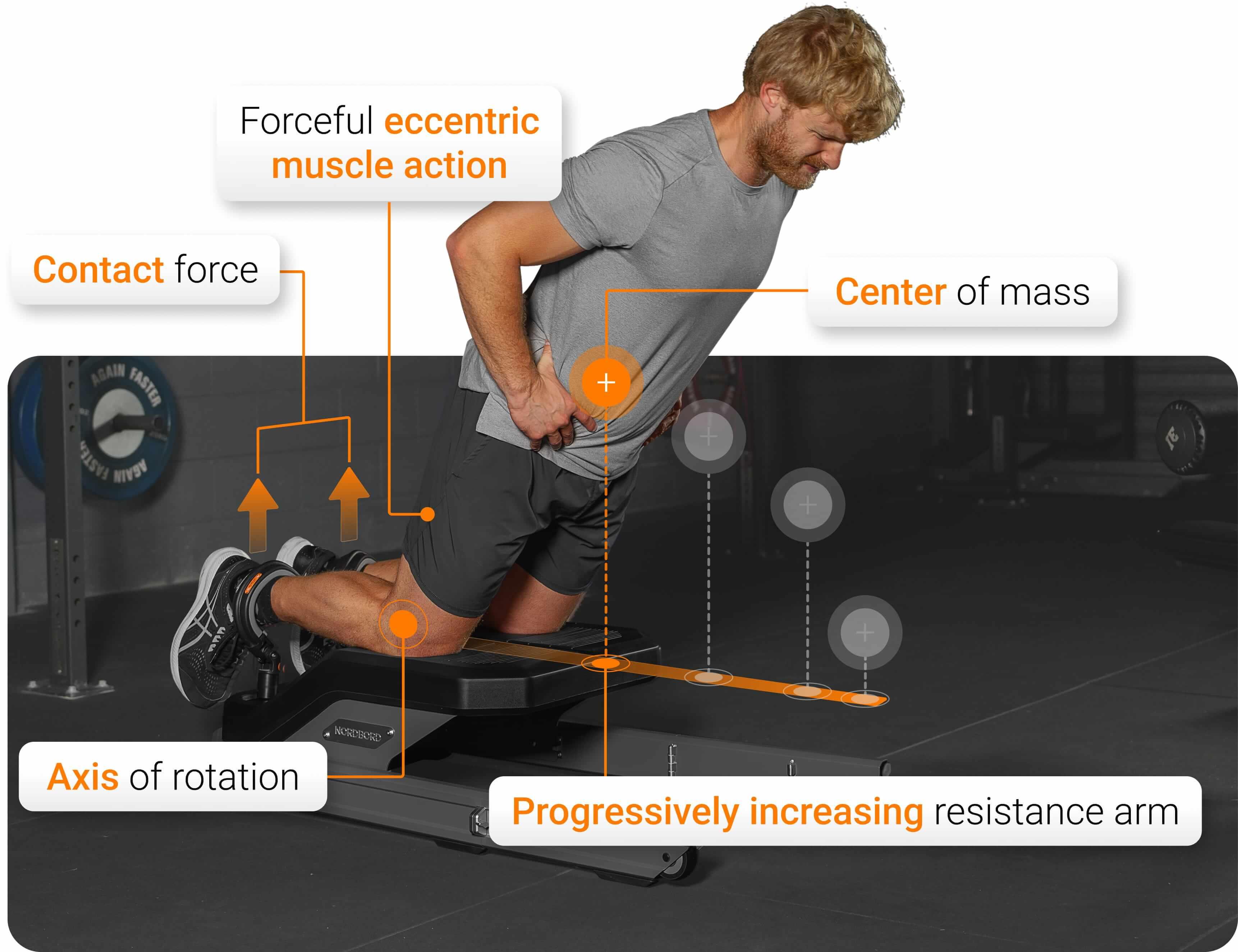
Mechanical demands of the NHE visualized.
The NHE is occasionally performed in ways that limit its unique benefits. Shortening the repetition or performing compensatory movements to avoid loading the hamstrings are often drivers of ineffective execution.
Technologies like NordBord produce identifiable waveforms, making execution faults easy to detect.
Technologies like NordBord produce identifiable waveforms, making execution faults easy to detect.
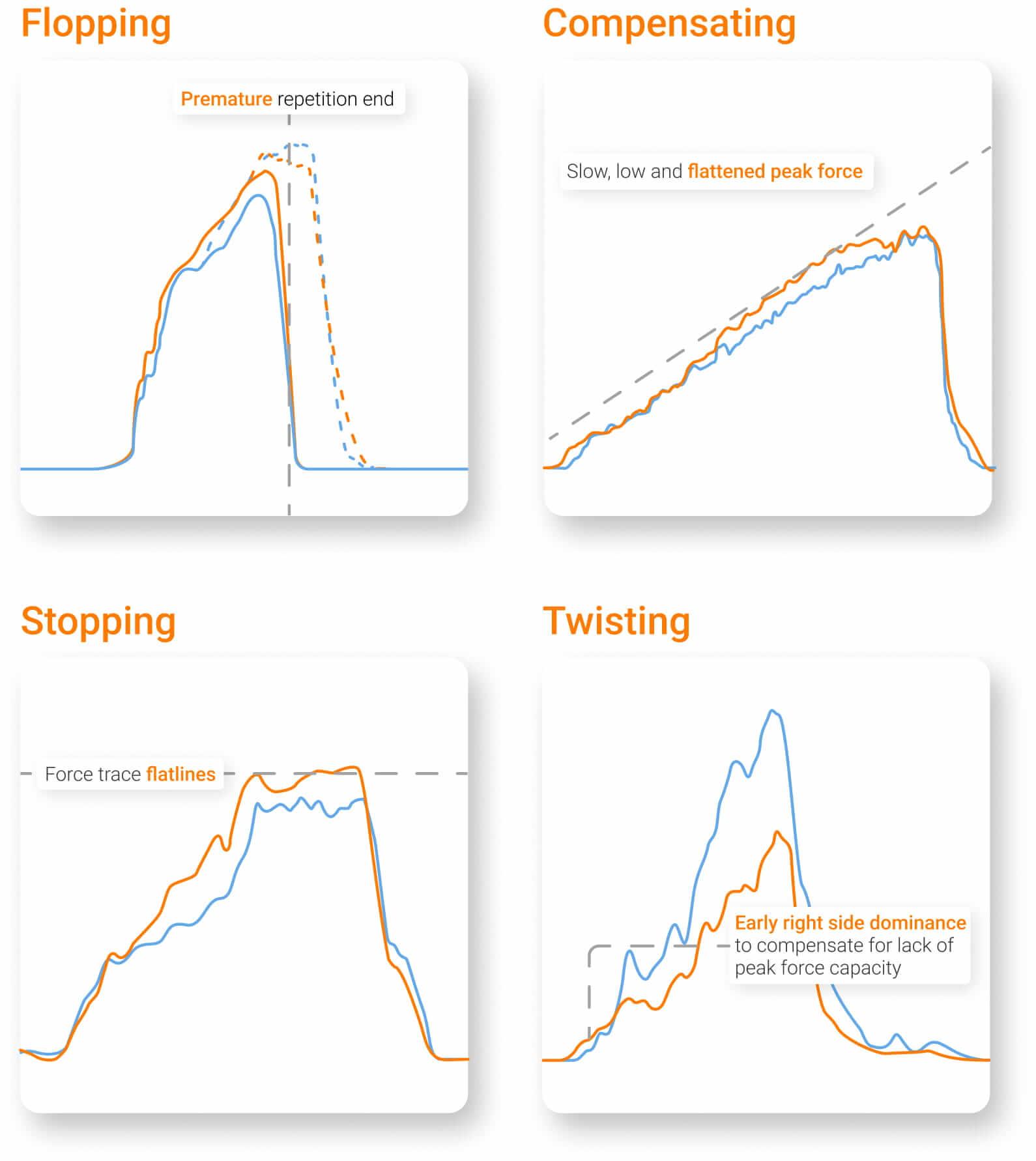
Four common faults detected by NordBord during the NHE.
The table below expands on the most common faults observed during NHE training and testing, along with the downstream consequences they can cause. Each fault is paired with practical coaching cues and alternative exercises, recognizing that poor execution not only reduces training effectiveness but also leads to the mistaken belief that adaptation has been achieved when the stimulus was insufficient.
| Faults | Outcomes | Cues | Alternative Exercises |
|
Flopping
Failing to resist the full range of motion | Low tension, low stimulus leading to minimal adaptation |
| Use Isometric Training Mode in the ISO Prone, ISO 30 and ISO 60 as a more appropriate stimulus for the athlete’s capacity |
|
Compensatory Movements
Descending through hip flexion rather than knee extension | Limited eccentric stimulus delivered to the distal hamstrings |
| Use Isometric Training Mode in the ISO Prone position to improve long-lever hamstring strength in a hip-extended position |
|
Stopping
Holding in mid-range to increase total impulse or delay time to repetition failure |
Incomplete eccentric repetition, potentially blunting the effects of the exercise |
| Use partial range Nordics from 45° and work on controlling descent to ground (takes out the low force component of the NHE) |
|
Twisting
Rotating during the exercise from excessive limb dominance | Uneven loading and decreased intensity on the weaker limb |
| Use NordBord Eccentric Training Mode to set a specific asymmetry threshold for effective repetitions |
For the NHE to deliver meaningful adaptations, whether for performance or injury risk reduction, technical execution matters. The exercise relies on a true eccentric overload stimulus, and when technique breaks down, that stimulus is reduced, limiting both training effectiveness and intended outcomes.
If an athlete struggles with execution, the NHE can be regressed to isometric holds at the point of breakdown or partial-range Nordics to reinforce control. NordBord feedback can then be used to guide and monitor progression.
NordBord Training Mode removes much of the guesswork by allowing practitioners to monitor force output and provide real-time feedback, helping ensure the appropriate eccentric load is achieved. Poor execution compromises eccentric demand, which can slow progress, distort training intent and reduce the value of the session.
NordBord was originally developed to move the NHE beyond simply counting sets and repetitions, enabling objective feedback, progress tracking and athlete comparison. While it has already become a trusted tool for field-based hamstring strength testing, the addition of features such as Training Mode, impulse measurement and isometric rate of force development (RFD) expands its role from assessment into daily training and rehabilitation.
Today, NordBord functions as both an assessment and training tool, supporting better execution, higher-quality loading and more informed decision-making.
…NordBord functions as both an assessment and training tool, supporting better execution, higher-quality loading and more informed decision-making.
To learn more about how NordBord can be used for training, monitoring and evaluation, read our Understanding the Nordic Hamstring Exercise Part 2 article.
For more information on implementing NordBord Training Mode or integrating NHE into performance or rehabilitation settings, get in touch with our team.

Copyright © 2026 VALD Health
.
All Rights Reserved |
Privacy Policy