Using Objective Testing to Guide Bone Stress Injury Rehabilitation
Available in:
EN

Managing bone stress injury (BSI) rehabilitation can be challenging for practitioners, particularly when determining progressions, regressions and readiness to return to running. While rest can reduce load on the injured bone, it does not independently restore strength, rate of force development (RFD) or the impact tolerance required for running or sports participation.
Rehabilitation should progressively restore the capacity of the muscles and tendons surrounding the injured bone while gradually exposing the athlete to greater mechanical loading. Over time, appropriate loading can support bone adaptation and prepare the athlete for the demands of their sport (Warden et al., 2021).
What many practitioners learn later in their careers is that the greatest loads experienced by bone do not come solely from ground reaction forces but can also result from the compressive and bending forces produced by muscle contraction.
…the greatest loads experienced by bone do not come solely from ground reaction forces but can also result from the compressive and bending forces produced by muscle contraction.
Therefore, quantifying the physical capacity of the body’s tissues and their tolerance to loading helps inform the progressions I make with the athletes I work with. In practice, data from tools like ForceDecks and ForceFrame helps support my decisions when working with complex pathologies such as BSIs.
Start With the Injury, Not the Numbers
Before progressing into strength or jump testing, I first determine whether the BSI occurred at a high- or low-risk site. This classification influences the required level of protection, the rate of loading progression and the criteria used throughout rehabilitation.
| Category | Low-Risk BSI | High-Risk BSI |
| Common Sites | Posteromedial tibia, most metatarsals | Femoral neck, navicular, anterior tibia |
| General Prognosis | Typically favorable with appropriate management | Typically less favorable due to greater risk of fracture progression or complications |
| Early Loading | May require only the minimum offloading necessary to remain symptom-free | Often requires greater protection and more conservative loading |
| Progression | Can generally progress based on symptoms, function and loading tolerance | Typically progresses according to stricter criteria and longer periods between loading stages |
| Additional Considerations | Clinical assessment and response to progressive loading | Greater role for imaging, specialist clearance and multidisciplinary management |
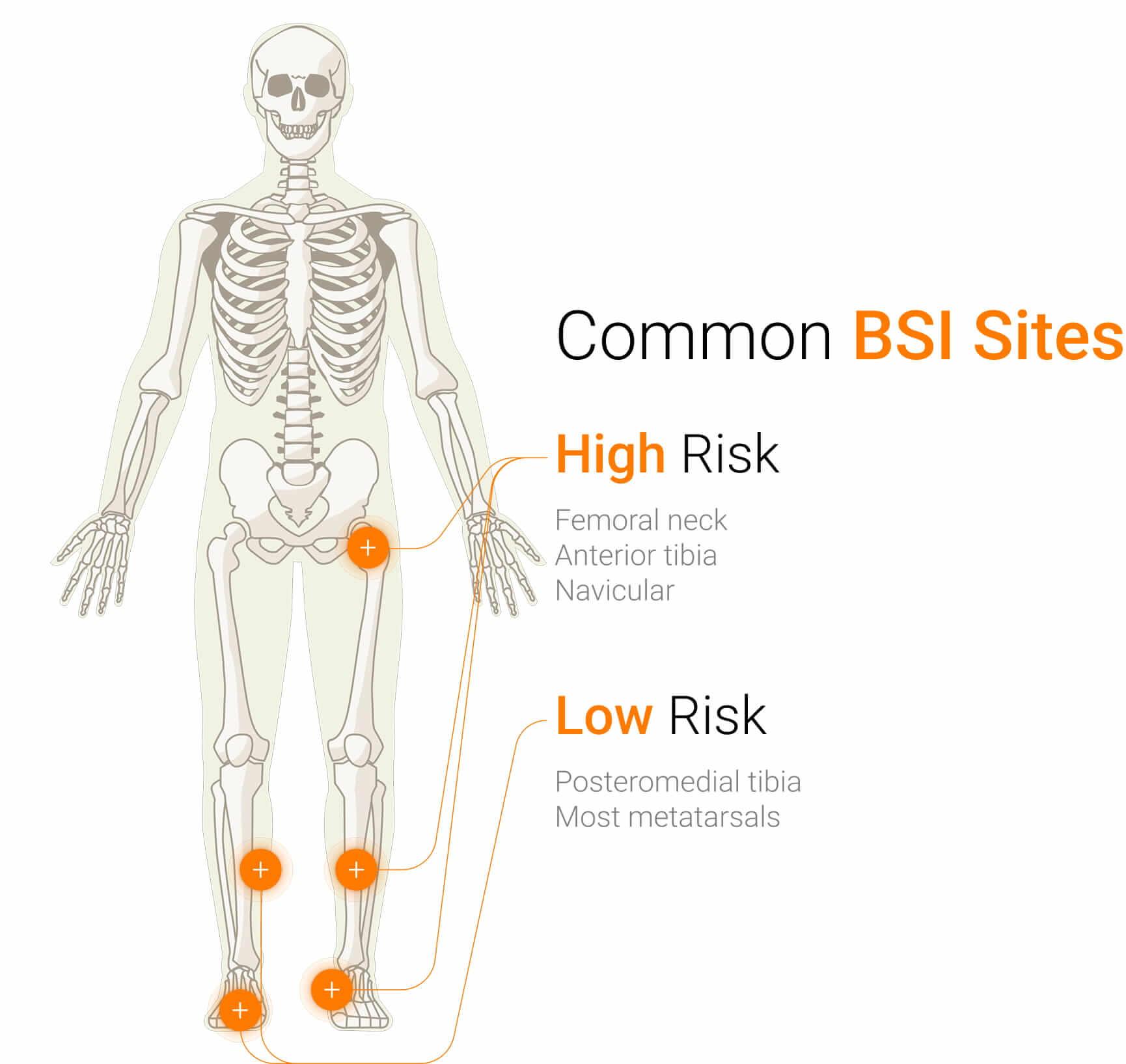
Low- and high-risk BSIs can follow the same general rehabilitation framework, but they should not progress through it in the same way. High-risk injuries typically require greater protection and additional evidence of healing (e.g., medical imaging) before progressing toward physical testing, impact and running (Hoenig et al., 2023; Warden et al., 2014).
For example, before maximal strength testing with either group, I generally want the following:
- Night and resting pain settled for approximately one week
- Pain-free activity at the athlete’s current weight-bearing level for at least three days (low-risk BSIs) or one week (high-risk BSIs)
- Reduced pain on palpation at the injury site (low-risk BSIs) or no pain on palpation (high-risk BSIs)
- Basic local muscular loading to be symptom-free, such as approximately 20 single leg heel raises for a lower-leg BSI, and resistance training to be pain-free
For high-risk BSIs, I also want evidence of improvement on imaging before introducing maximal testing, while imaging findings, specialist input and other injury-specific considerations continue to influence later progression decisions.
Build Strength Before Adding Impact
Once an athlete can tolerate maximal testing, I begin establishing whether they have sufficient muscular capacity to progress toward impact. Ground reaction force alone does not describe the load an individual bone experiences. Muscular forces also contribute substantially to internal bone loading (Scott & Winter, 1990; Matijevich et al., 2019). Restoring muscular capacity is therefore an important part of preparing the athlete for impact.
For a tibial BSI, for example, this may involve restoring calf, foot and ankle strength before progressing to faster calf actions, pogos, hopping and jumping. Exercise selection should still reflect the individual athlete, injury location and eventual sporting demands.
Exercise selection should still reflect the individual athlete, injury location and eventual sporting demands.
I use objective testing technologies such as ForceDecks to quantify progression. For a low-risk tibial BSI, one criterion I use before introducing impact is achieving a peak force of approximately 2.35 × body weight (BW) during a Run-Specific Ankle Iso-Push, with BW included in the measurement.
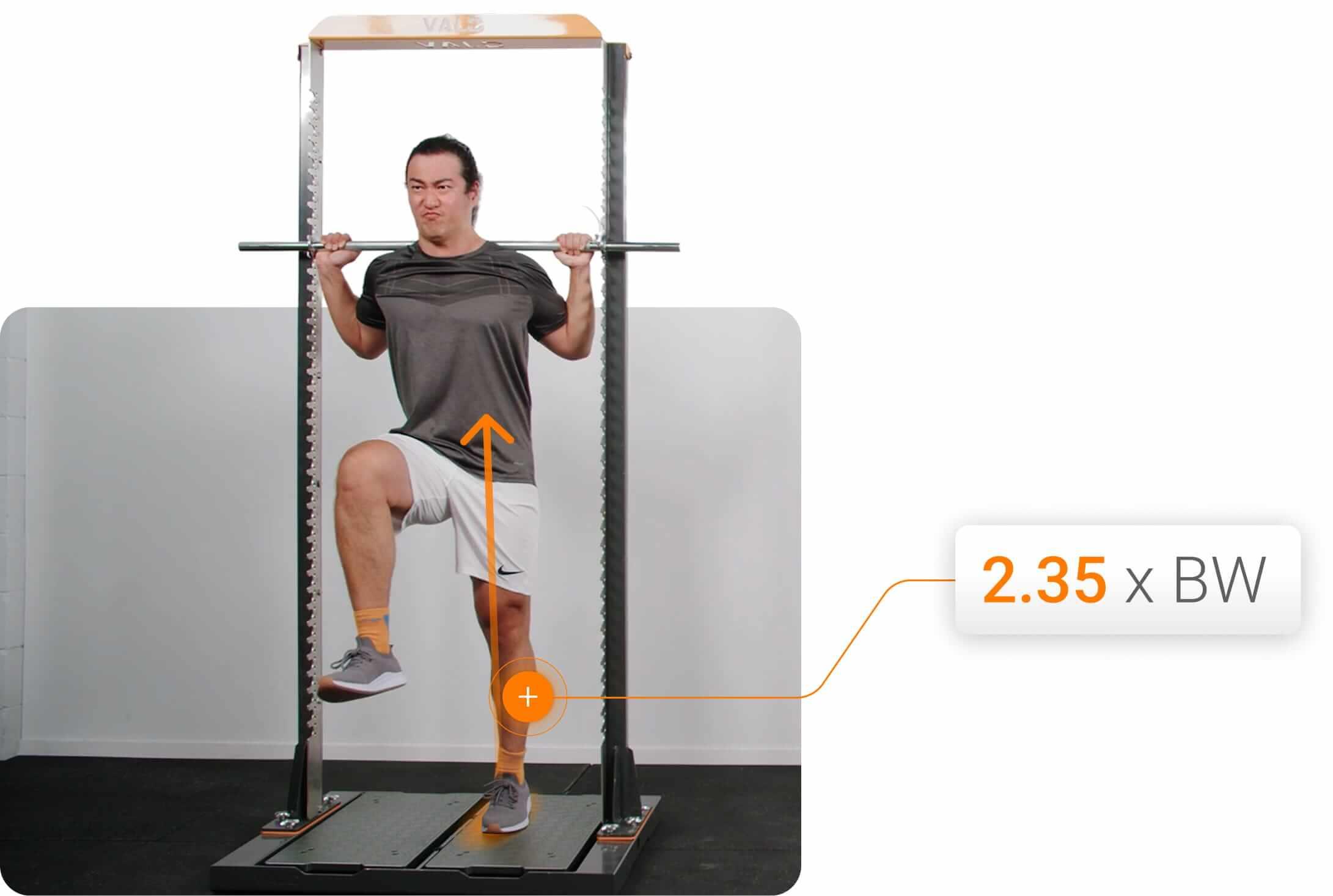
This threshold is not a definitive pass-or-fail criterion, but an objective reference point interpreted alongside symptoms, loading history and other assessment findings.
Progress From Strength to Plyometrics
Once sufficient strength has been restored, I progressively introduce impact, typically beginning with bilateral pogos before progressing to staggered, unilateral and more demanding hopping and jumping tasks as tolerance improves. This order suits shin BSIs. For BSIs higher up the leg, I also add knee- and hip-dominant jumping and landing tasks to load the bone closer to the injury.
Once sufficient strength has been restored, I [start with]…pogos before progressing to staggered, unilateral and more demanding hopping and jumping tasks as tolerance improves.
Testing progresses alongside these demands. Strength assessments quantify force-producing capacity, while jump testing provides insight into how force is expressed and managed during faster tasks. I therefore progress from isolated strength testing to pogo and hop tests, followed by countermovement jump (CMJ) testing on ForceDecks.
Bone becomes less responsive to repeated mechanical loading within a single bout, meaning shorter bouts separated by recovery may provide a more effective osteogenic stimulus than the same volume accumulated continuously (Hughes et al., 2017; Robling et al., 2002; Warden et al., 2021). For plyometric loading, more contacts are therefore not necessarily better.
Before progressing to running, I generally aim for approximately three weeks of progressive, symptom-free plyometric loading, alongside continued improvement in objective measures.
Establish Criteria for Returning to Running
Because running substantially increases cumulative loading, I consider a combination of strength, plyometric performance and symptom response. For high-risk BSIs, I use the same strength-to-impact-to-running framework but add criteria specific to the injured region. I also generally require at least two weeks without pain before impact and, for stress fractures, appropriate healing on imaging and specialist clearance before running.
The testing battery should therefore reflect the location and demands of the injury. For example, above-knee BSIs place greater emphasis on hip capacity, while anterior tibial BSIs include additional ankle strength assessments. My current return-to-running benchmarks include:
| System | Assessment | Metric | Approximate Benchmark | Application |
| ForceDecks | Run-Specific Ankle Iso-Push | Peak force / BW | 2.6 × BW | Lower-leg BSI |
| Hop test | Reactive strength index (RSI) | 1.75 | Lower-leg BSI | |
| Single leg hop test | RSI | 0.8 | Lower-leg BSI | |
| ForceFrame | Ankle plantar flexion | Peak force / BW | 1.65 × BW | Lower-leg BSI |
| Ankle inversion | Peak force / BW | 31% BW | Lower-leg BSI | |
| Great-toe flexion | Peak force / BW | 54% BW | Lower-leg BSI | |
| Hip abduction | Peak force / BW | 25% BW | Above-knee BSI | |
| Hip adduction | Peak force / BW | 48% BW | Above-knee BSI | |
| Hip flexion | Peak force / BW | 34% BW | Above-knee BSI | |
| Hip extension (prone) | Peak force / BW | 88% BW | Above-knee BSI | |
| Ankle eversion | Peak force / BW | 22% BW | Anterior tibial BSI |
…above-knee BSIs place greater emphasis on hip capacity, while anterior tibial BSIs include additional ankle strength assessments.
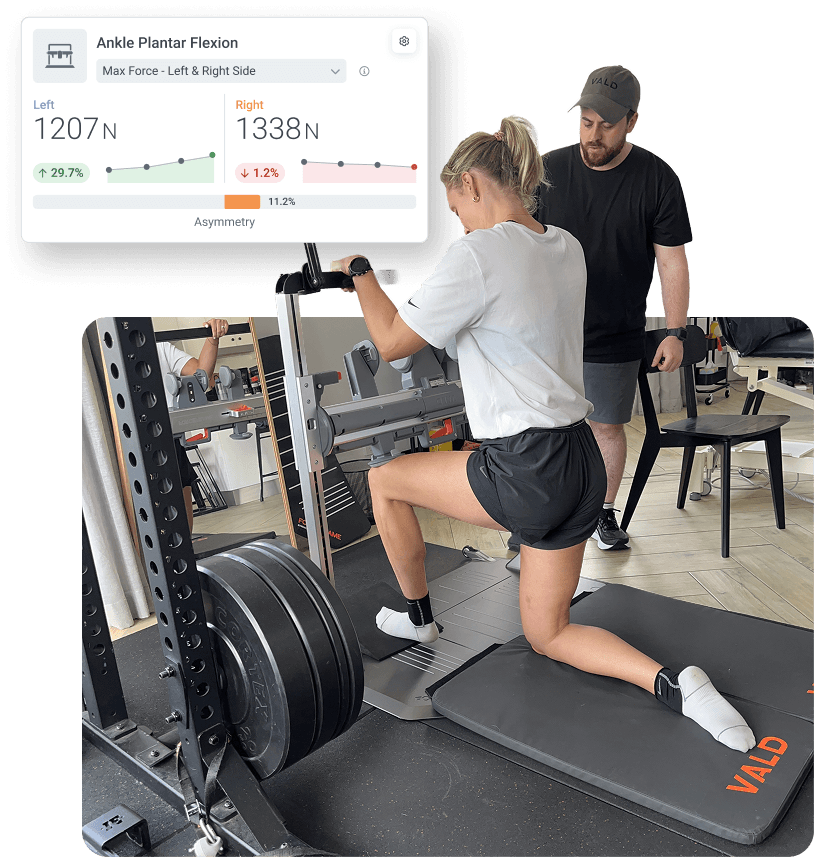
Strength assessments can be quantified with ForceFrame, while hopping and other dynamic assessments can be measured with ForceDecks. I generally aim for less than 2 to 4% asymmetry on isolated strength tests where normative data exist and less than 10% on noisier tests, such as bilateral and unilateral pogos, or when data is limited. However, I interpret these differences alongside absolute values, previous testing and relevant normative data to better understand the athlete’s performance.
From Running to Performance
Meeting return-to-running criteria does not mean rehabilitation is complete. I consider early running exposures an extension of the assessment process, determining whether strength and plyometric capacity transfer to repeated loading. Running volume can then progress based on symptoms, between-session response and total daily exposure, including walking and step count.
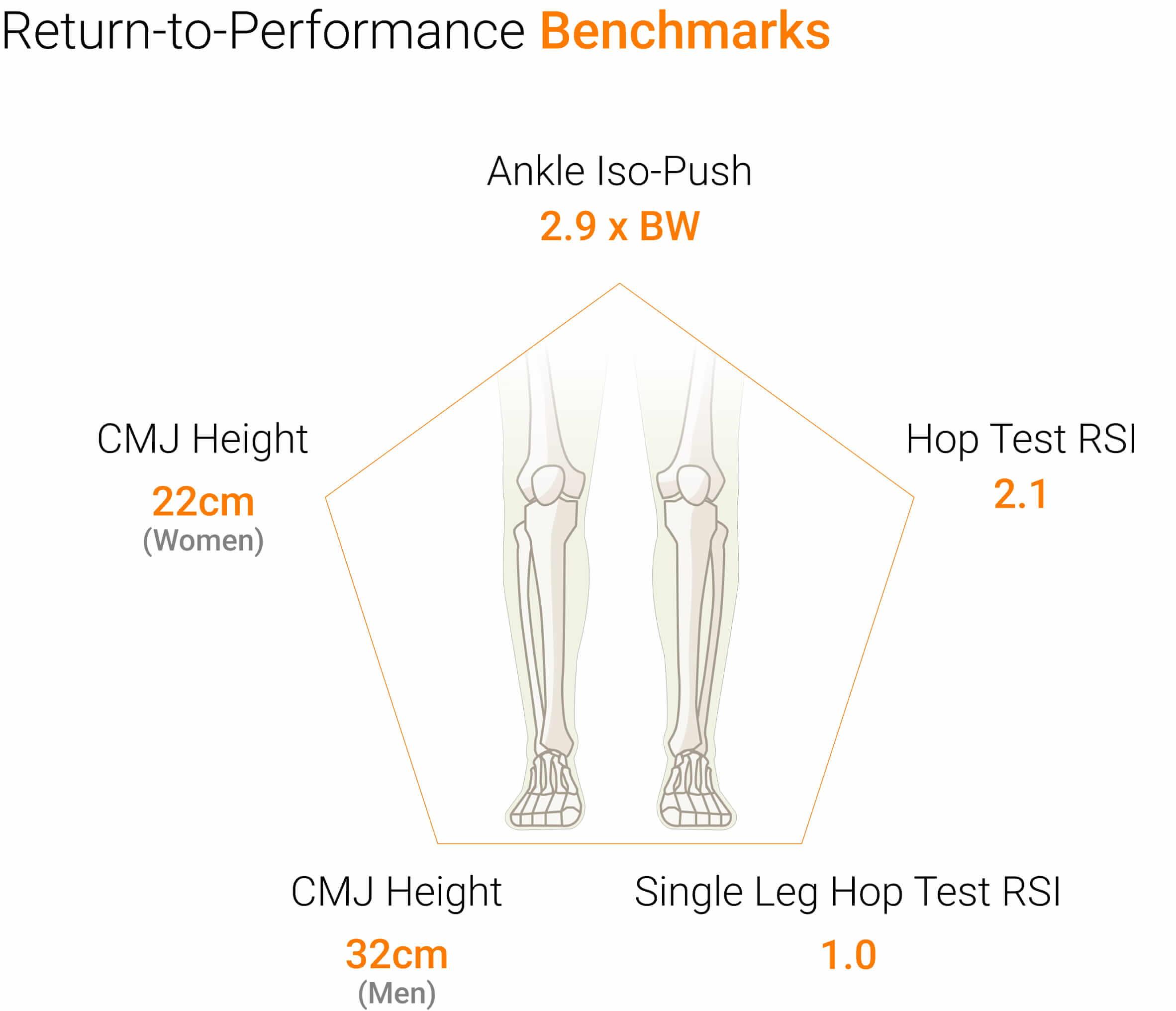
As tolerance improves, testing shifts toward return-to-performance and return-to-sport demands. My current reference points include approximately 2.9 × BW for the Run-Specific Ankle Iso-Push, 2.1 hop test RSI, 1.0 single leg hop test RSI and CMJ heights of approximately 32cm for men and 22cm for women. Strength and pogo benchmarks differ slightly between men and women, while CMJ height differs more substantially. These criteria complement, rather than replace, progressive exposure to running, training and sport-specific demands.
Bringing the Process Together
Technology does not provide a single test to determine readiness following a BSI. Instead, it helps quantify progression from strength and impact tolerance through plyometric testing, running and return to performance, providing objective information at each stage.
Objective testing should complement clinical reasoning and broader considerations such as symptoms, injury characteristics, energy availability, nutrition, sleep, hormonal health, imaging and medical history. Combining these factors with strength and performance data can help practitioners identify what has been restored, what remains limited and when progression may be appropriate.
If you are interested in learning how ForceDecks and ForceFrame can support objective testing throughout BSI rehabilitation, get in touch with our team.
References
- Hoenig, T., Eissele, J., Strahl, A., Popp, K. L., Stürznickel, J., Ackerman, K. E., Hollander, K., Warden, S. J., Frosch, K. H., Tenforde, A. S., & Rolvien, T. (2023). Return to sport following low-risk and high-risk bone stress injuries: a systematic review and meta-analysis. British Journal of Sports Medicine, 57(7), 427–432. https://doi.org/10.1136/bjsports-2022-106328
- Hughes, J. M., Popp, K. L., Yanovich, R., Bouxsein, M. L., & Matheny, R. W., Jr. (2017). The role of adaptive bone formation in the etiology of stress fracture. Experimental Biology and Medicine, 242(9), 897–906. https://doi.org/10.1177/1535370216661646
- Matijevich, E. S., Branscombe, L. M., Scott, L. R., & Zelik, K. E. (2019). Ground reaction force metrics are not strongly correlated with tibial bone load when running across speeds and slopes: Implications for science, sport and wearable tech. PloS One, 14(1), e0210000. https://doi.org/10.1371/journal.pone.0210000
- Robling, A. G., Hinant, F. M., Burr, D. B., & Turner, C. H. (2002). Shorter, more frequent mechanical loading sessions enhance bone mass. Medicine and Science in Sports and Exercise, 34(2), 196–202. https://doi.org/10.1097/00005768-200202000-00003
- Scott, S. H., & Winter, D. A. (1990). Internal forces of chronic running injury sites. Medicine and Science in Sports and Exercise, 22(3), 357–369.
- Warden, S. J., Davis, I. S., & Fredericson, M. (2014). Management and prevention of bone stress injuries in long-distance runners. The Journal of Orthopaedic and Sports Physical Therapy, 44(10), 749–765. https://doi.org/10.2519/jospt.2014.5334
- Warden, S. J., Edwards, W. B., & Willy, R. W. (2021). Optimal load for managing low-risk tibial and metatarsal bone stress injuries in runners: The science behind the clinical reasoning. The Journal of Orthopaedic and Sports Physical Therapy, 51(7), 322–330. https://doi.org/10.2519/jospt.2021.9982
