From Anatomy to Performance: A framework for managing injuries in elite athletes
Available in:
EN

How Objective Assessment Can Support Clinical Decision-Making and Individualized Rehabilitation
Practitioners working in rehabilitation are tasked with understanding both anatomy and function. The injured structure may shape the early stages of rehabilitation, but the process also requires an understanding of the physical qualities needed to restore performance and the accessory qualities that may be affected by potential detraining and reduced performance exposure.
Objective testing helps connect these areas. As a practitioner, my approach starts by assessing foundational physical qualities through isometric testing on systems such as ForceFrame and DynaMo before progressing to functional and sport-specific demands, including jump assessments on ForceDecks. Each assessment helps determine what needs attention and whether the intervention is producing the intended response.
Start with the Anatomy
My physiotherapy background provides an anatomical perspective that complements the functional approach I previously developed as a strength and conditioning coach. In rehabilitation, this starts with understanding the injured structure and the physical qualities that may influence recovery before progressing toward more complex, sport-specific demands.
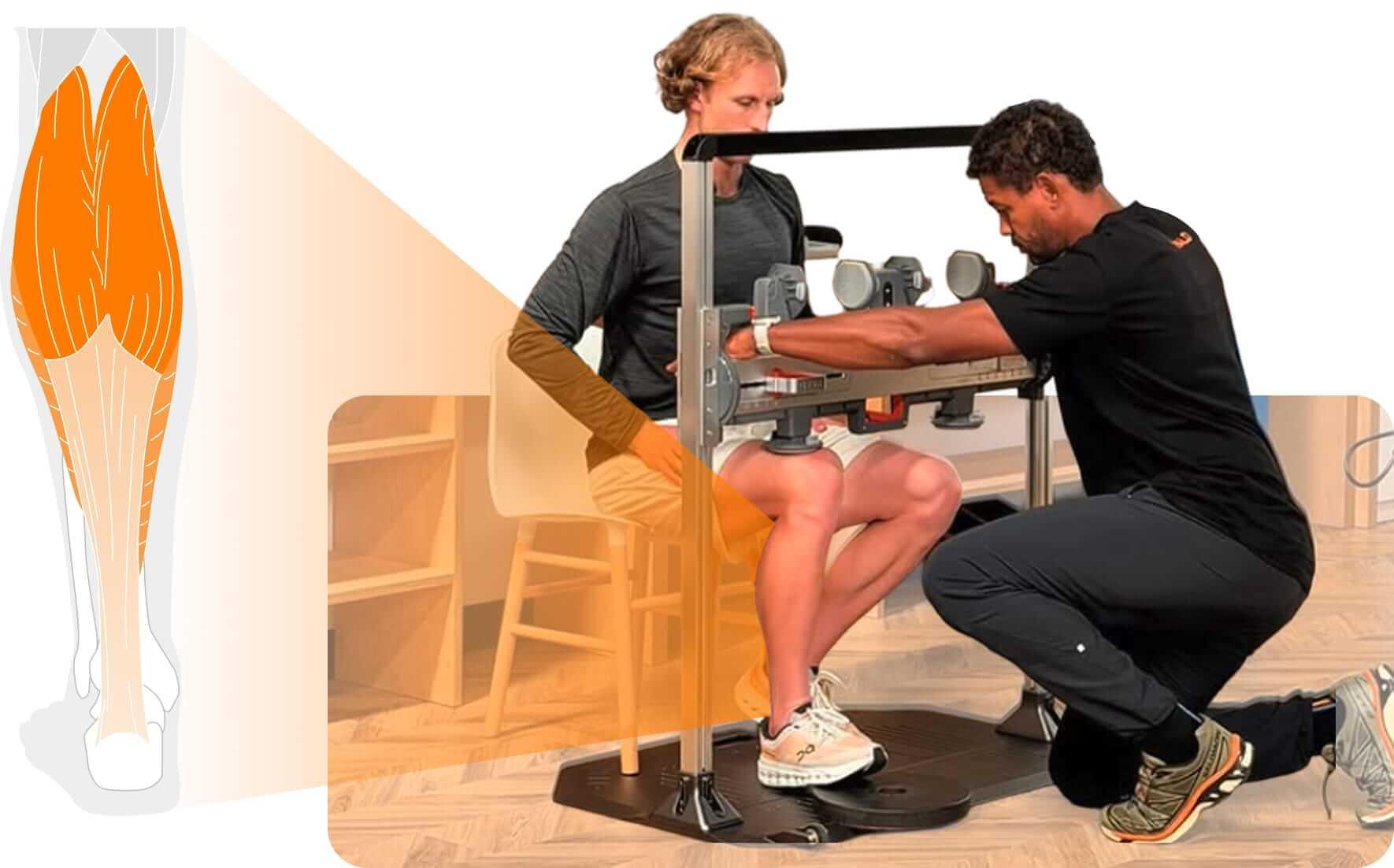
Athlete performing a seated ankle plantar flexion test using ForceFrame to assess plantar flexion strength.
Range of motion, strength, proprioception and movement control provide an initial foundation for assessment and training. As these qualities develop, new assessments can be integrated to progress toward how they are expressed within the athlete’s sport and the specific demands they need to tolerate.
Functional testing is an important part of this process but may not always explain the individual factors contributing to performance. For example, a single leg drop jump on ForceDecks may identify reduced reactive strength, but a separate underlying quality may drive this deficit. Therefore, practitioners need to identify the unique, independent physical qualities that are currently limiting the athlete’s progression in rehabilitation.
…a single leg drop jump…may identify reduced reactive strength, but a separate underlying quality may drive this deficit.
In basketball, athletes require considerable power, reactive strength, endurance and maximal force capacity. However, in a recent case, ForceDecks testing highlighted limitations during unilateral plyometrics, which aligned with the athlete’s reported pain and poor performance when accelerating. A single leg drop jump identified a unilateral deficit, while seated ankle plantar flexion testing also revealed reduced soleus strength, providing a more specific quality to address in his program.
Following progressive strengthening, plantar flexion strength increased by approximately 40% alongside improvements in single leg drop jump performance. These physical quality changes ultimately influenced the athlete’s performance, leading to an improvement in their perceived ability to drive to the basket.
While these changes do not establish soleus strength as the cause of improved performance, combining targeted physical assessments with functional testing provided greater context around the athlete’s limitations and helped guide subsequent training.

Build the Assessment Around the Athlete
As rehabilitation progresses, testing should increasingly reflect the athlete’s specific demands rather than the sport alone. Even athletes competing in the same sport may rely on different movement strategies and physical qualities, which can influence what should be assessed.
As rehabilitation progresses, testing should increasingly reflect the athlete’s specific demands rather than the sport alone.
The same applies across sporting disciplines. Trail runners encounter climbs, descents and constantly changing terrain, while road runners often encounter less steep hills and a more consistent training environment. Although both sports involve competitive running, differences in performance demands and common injuries will shape the tests used throughout rehabilitation. Testing can begin with foundational qualities before progressing toward the movements and demands most relevant to the individual athlete.
Specificity also matters when interpreting results. Testing position, setup and stabilization can influence the values produced, especially in assessments commonly used by rehabilitation practitioners, such as:
- Seated knee extension
- Seated ankle plantar flexion
- Shoulder external rotation
- Countermovement jump (CMJ)
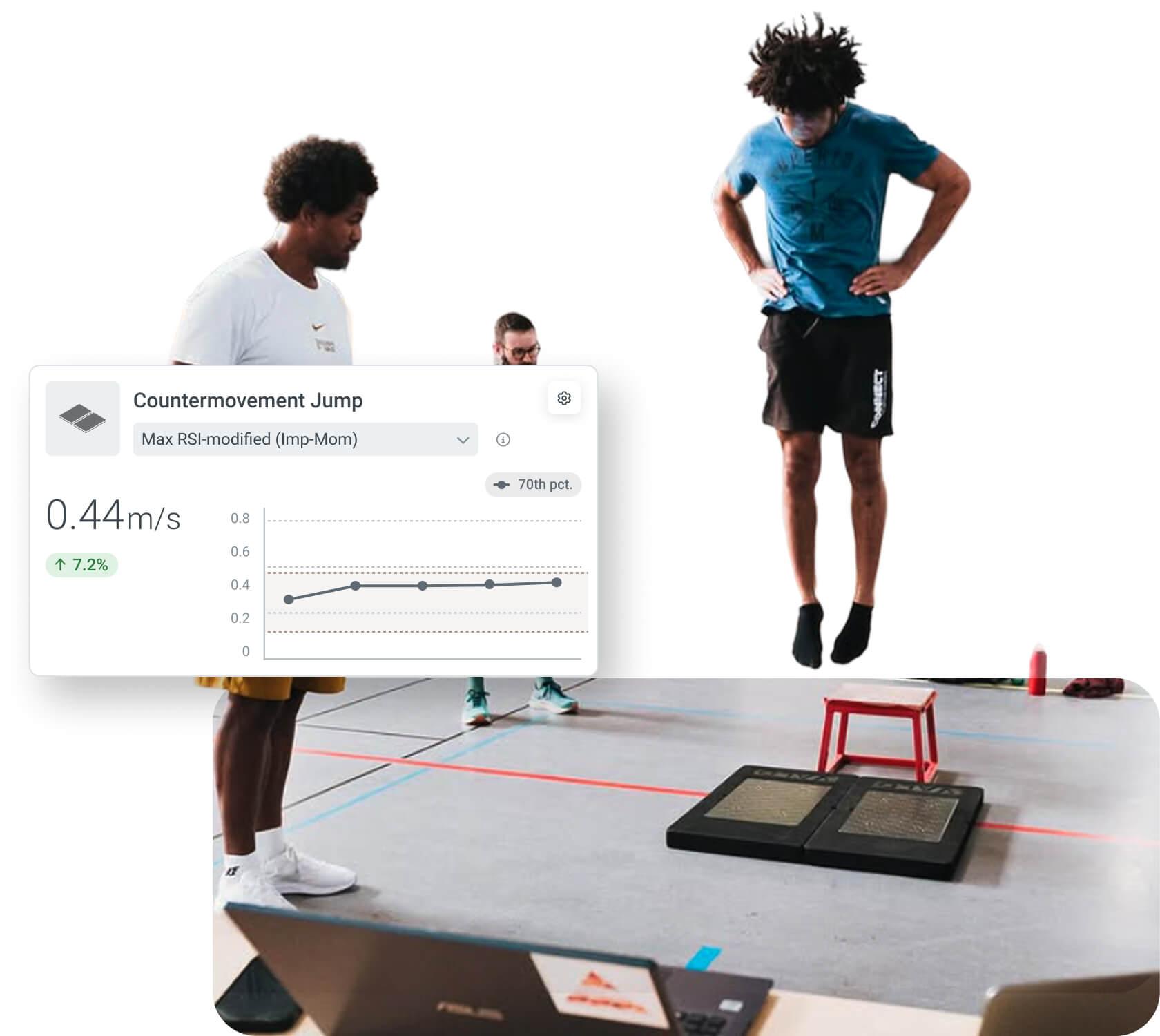
CMJ testing on ForceDecks, with longitudinal tracking to monitor performance changes.
Consistent protocols, as provided through VALD Knowledge Base and the Practitioner’s Series, help ensure each assessment is conducted correctly. Similarly, practitioners should use reference data from comparable populations rather than relying solely on external benchmarks. Resources such as VALD Norms and the Normative Data Reports available in VALD Hub help support accurate benchmarking based on the populations I work with.
Test According to the Question
Testing frequency should reflect the quality being monitored and how quickly meaningful change can reasonably be expected. More frequent testing is not necessarily more informative if the underlying quality has not had sufficient time or stimulus to change.
For example, when inhibited by pain, peak force and asymmetries can change as quickly as the pain resolves, whether within a single session or over a couple of weeks. However, if performance characteristics are limited by structural adaptations following substantial atrophy, changes in performance typically require longer periods of time. The testing schedule should therefore follow the clinical question rather than a predetermined calendar:
- Pain or Activation-Related Changes: Testing may occur frequently or even within the same session when appropriate.
- Structural Changes and Substantial Atrophy: Longer intervals may be appropriate. In my practice, this can mean approximately three weeks between assessments.
…when inhibited by pain, peak force and asymmetries can change as quickly as the pain resolves…if performance characteristics are limited by [anatomy], changes in performance typically [take] longer…
Repeated maximal efforts can also provide useful context beyond a single peak value. Athletes may require several attempts to become familiar with the testing task and understand how to produce maximal force in a specific position. As a result, early attempts may underestimate their true capacity.
If performance continues to improve across repetitions, I will typically continue testing until force output plateaus or begins to decline. This helps ensure the recorded result reflects the athlete’s current maximal capacity rather than simply their best effort within a predetermined number of attempts.
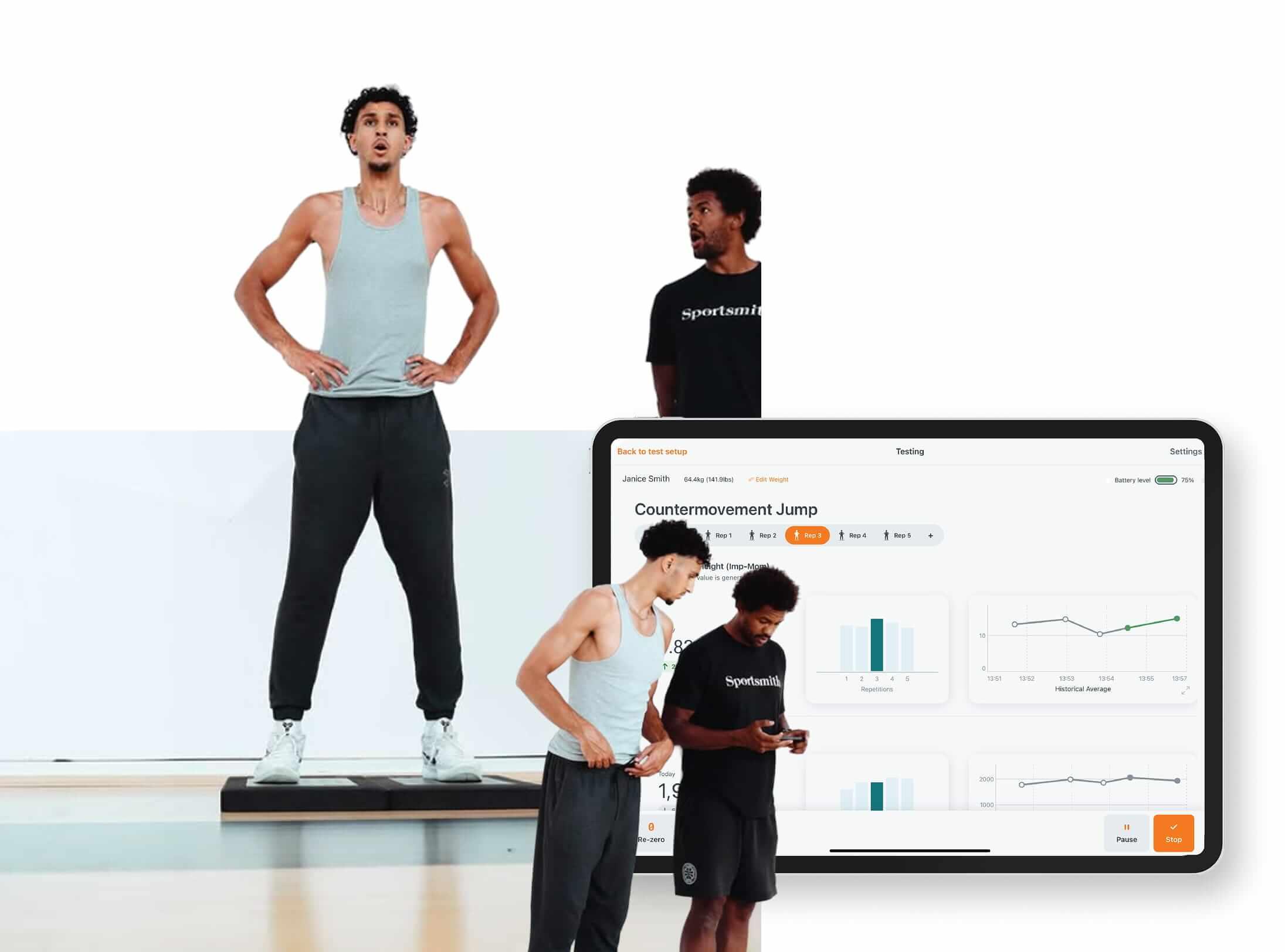
Athlete completing repeated CMJs, with performance changes tracked across attempts in the ForceDecks app.
My goal is to get the most accurate representation of the athlete’s capacity. Rather than setting an arbitrary three-repetition limit on every test I conduct, I ensure the athlete performs the test to the best of their ability over a minimum of three to five repetitions. This helps ensure changes in performance results reflect true change rather than habituation or a learning effect from the testing environment.
Be More Ambitious with Symmetry
Limb symmetry is useful during rehabilitation, but similar performance between limbs does not necessarily indicate sufficient capacity. Both limbs may be equally underprepared, and a small residual deficit can fall within an accepted symmetry range without demonstrating that the previously injured limb is ready for performance. Symmetry should therefore be interpreted alongside absolute capacity.
In my practice, I am deliberately ambitious with the previously injured side. When both limbs show sufficient capacity, I may aim for the injured side to equal or slightly exceed the uninvolved side, sometimes by approximately 0-5%. This reflects my clinical philosophy rather than a universal return-to-sport criterion, particularly when deficits in other qualities, such as proprioception, may remain.

Because strength is only one part of rehabilitation, I also consider qualities like power, mobility, reactive strength and endurance independently, as athletes with the same injury can present with very different limitations. The priority is to identify the specific deficit – whether maximal strength or another quality – and determine how it affects function.
…I also consider [multiple physical] qualities…independently, as athletes with the same injury can present with very different limitations.
Use Data to Make Decisions
Objective testing is most valuable when it influences what happens next. A result should help determine whether a quality requires intervention, how much priority it deserves and whether the intervention is producing the intended response. Even a lack of improvement can be informative, providing a reason to reconsider the approach rather than continuing an intervention that is not producing change.
The value of testing also increases when data is collected consistently over time. Longitudinal results can provide context for individual athletes, establish reference values within specific populations and help determine whether observed patterns are supported by the data. This becomes more difficult when results are distributed across devices, spreadsheets and isolated records.
Ultimately, testing should support a decision. Before measuring a quality, practitioners should understand how the result could influence assessment, training or rehabilitation. Collecting more data is not the objective; collecting information that changes or supports a decision is.
If you would like to learn more about how objective assessment can support clinical decision-making and individualized rehabilitation, get in touch with our team.
